

News   Jan 08, 2026
 189     0 
News   Jan 07, 2026
 596     0 
News   Jan 07, 2026
 732     0 

VIA Rail

I hope I am wrong reporting this, but...
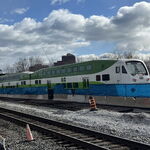
Due to losses of HEP on seven recent Venture-equipped trains within a week, a new configuration
is the result: VIA will start to add a 6400-series locomotive to the cab-car end of Ventures train set effective tomorrow, January 5.
What type of loco is a 6400? P42, F40 or Charger?
 
Are the HEP systems compatible? Since they cannot be MU'ed the F40 would need to tow the Siemens set. At least there won't be any shunt issues.

Also not all of the 6400's are able to go backwards at full speed.

This is such a MacGuyverish solution that the shunt issues are indeed secondary. One wonders how the braking will work - although I have been told that the cabcar end only has an old fashioned automatic brake control without the blended electronic control features that the locomotive cab has.

The trainsets will still be four axles short of relief from the shunt restrictions.

Is it not possible to add a HEP generator in the locomotive? I understand this is a temporary measure until the kinks are worked out.

What, just squeeze in a Honda generator in the passageway somehow? There's a little more to the HEP than that.

- Paul
 
This is such a MacGuyverish solution that the shunt issues are indeed secondary. One wonders how the braking will work - although I have been told that the cabcar end only has an old fashioned automatic brake control without the blended electronic control features that the locomotive cab has.

The trainsets will still be four axles short of relief from the shunt restrictions.


What, just squeeze in a Honda generator in the passageway somehow? There's a little more to the HEP than that.

- Paul
That would give different performance characteristics from running locomotive forward, why would they use such a design?

Does anyone have proof that they actually did this?

Are there enough spare f40's do do this?

Also trains will now be limited to 95mph.
 
This was forwarded to me to post here.

1767625905701.png
 
At least the horn will be quieter for cab car passengers.
I guess they didn't learn their lesson about having the prime mover provide tractive effort and HEP.

There's a lot of precedent for drawing HEP off the prime mover, and Siemens has a lot of experience with doing so. There are pro's and cons to the design, but overall I'm surprised if Siemens hasn't got this right on these units as this is not a "first" for them. Remember the HEP is integrated into the power train such that regen braking feeds HEP etc.

- Paul
 
This is such a MacGuyverish solution that the shunt issues are indeed secondary. One wonders how the braking will work -
The same as if a regular passenger car was being towed by a Siemens set. Which has happened, as we all know. Just set the brake valve to trail, and connect up the main and res lines to the rest of the train.

although I have been told that the cabcar end only has an old fashioned automatic brake control without the blended electronic control features that the locomotive cab has.
This is incorrect, and one of the main reasons why the trains were built with Cat5 for MU rather than sticking with the traditional 27-pin MU and COMM. The controls are the same at both ends, and for the most part the performance of the trains is identical regardless of the end of the train they are operating from.

What, just squeeze in a Honda generator in the passageway somehow? There's a little more to the HEP than that.

- Paul
Right? Perhaps a bit more thought should be given before throwing out ideas willy-nilly.

Dan
 
The same as if a regular passenger car was being towed by a Siemens set. Which has happened, as we all know. Just set the brake valve to trail, and connect up the main and res lines to the rest of the train.


This is incorrect, and one of the main reasons why the trains were built with Cat5 for MU rather than sticking with the traditional 27-pin MU and COMM. The controls are the same at both ends, and for the most part the performance of the trains is identical regardless of the end of the train they are operating from.

All true, what I was trying to say (badly) was whether a leading F40 could activate the blended braking ( which I don't claim to understand in detail) versus simply controlling the trainset automatic brake via brakeline pressure. The brakes still work, but differently.

I do understand that there is no control of the independent brake from the cabcar end. That may not matter when the F40 is pulling, but would possibly matter when it is shoving.

- Paul
 
All true, what I was trying to say (badly) was whether a leading F40 could activate the blended braking ( which I don't claim to understand in detail) versus simply controlling the trainset automatic brake via brakeline pressure. The brakes still work, but differently.

I do understand that there is no control of the independent brake from the cabcar end. That may not matter when the F40 is pulling, but would possibly matter when it is shoving.

- Paul
According to groups.io (Lion Liu) the F40 will be dead in tow when at the rear, and was chosen as opposed to P42 due to being lighter.
 
According to groups.io (Lion Liu) the F40 will be dead in tow when at the rear, and was chosen as opposed to P42 due to being lighter.
And they are more of them to go around.

Will Siemens be footing the bill for extra fuel and axle costs?

Not to mention wear and tear on the F40's when they are supposed to be send in for rebuild.

Has anyone seen the "pink" one that was rebuilt?
 
Maybe I haven’t quite followed properly: what is the reason for adding the F40 locomotive?
Siemens Chargers are "kaput" in colder climates.

I've heard some folks (who know more than I do) suggest that the way the Chargers are designed, too much of the inner mechanics and electronics are too exposed to outside temperatures.
 

Back
Top