


Urban Sky
Senior Member
At least in the case of the Brockville Sub (Smiths Falls to Brockville), this shouldn’t be a problem, as that line is ex-CP, not ex-CN.VIA’s own tracks (Brockville-Ottawa-Coteau, Chatham-Windsor) are ex-CN, right?
|
|
|
At least in the case of the Brockville Sub (Smiths Falls to Brockville), this shouldn’t be a problem, as that line is ex-CP, not ex-CN.VIA’s own tracks (Brockville-Ottawa-Coteau, Chatham-Windsor) are ex-CN, right?


As I wrote on groups.io, not all issues can be detected during testing:It's completelyl absurd how they are noticing this now, in operational trains with passengers, but didn't notice it when they were running empty during tests?
Some issues are so rare (e.g., once-in-a-million train-miles travelled or level crossings encountered) that they don’t get detected during testing or even after years of operations, but once they are detected, they are so potentially dangerous that they require additional safety procedures (such as automatic warning devices at level crossings which don’t get activated when required).
Testing catches a large number of issues you’ll never hear about (because they have been resolved before the first passenger sets foot into them), but others are just so infrequent they only surface after years of revenue operations…
 groups.io
For someone who understands less about rail operations and safety than quite a few other commenters here, your comments here appear to me as strikingly opinionated and judgemental…GIven this gross incomptence appears to be entirely CN's fault, the temporary solution shouldn't be to slow trains. It should be to post CN staff at each and every impacted level crossing, so as to manually close the gates when VIA trains are approaching.
My understanding is that both side have waived the right to demand compensation from each other in the case of accidents and you can find examples for when that presumably worked in favour of CN (Hinton) or of VIA (Burlington)…Hopefully VIA Rail get's cost recovery from CNR.
Do you have a source for that agreement?For someone who understands less about rail operations and safety than quite a few other commenters here, your comments here appear to me as strikingly opinionated and judgemental…
My understanding is that both side have waived the right to demand compensation from each other in the case of accidents and you can find examples for when that presumably worked in favour of CN (Hinton) or of VIA (Burlington)…

Why stop at Washago? Presumably CN uses the same detection technology all the way to Toronto, and Metrolinx may not have changed it out at Pottery Road.Will this be an issue for Ontario Northland on the portion between Washago and North Bay?
Why stop at Washago? Presumably CN uses the same detection technology all the way to Toronto, and Metrolinx may not have changed it out at Pottery Road.
And maybe this has been the problem all along, but people have been too afraid of calling CN out.This is where I think we have to take the longer broader view. CN has run its idiosyncratic signal design for many decades, and never has a regulator or government told them to get with the plan and standardise with other railways away from the low voltage designs. So effectively, what they are doing is legitimised technically and in a regulatory sense. Signal engineers on other railroads may roll their eyes and mutter, but if CN's practice has never been challenged, it "meets code" just as well as what the other railroads do. Hence my view that there has been an elephant in the room all along.
I'm not so sure that no one said anything. Sure, there certainly hasn't been much about it in the railfan press other than to write off the Siemens equipment as "cheap". Except it wasn't the equipment's fault at all.....Again, when CN made these demands in the US, nobody told them to smarten up. CN's infrastructure was there first. Amtrak may have caved, er, conceded.... but they added the extra cars instead of seeking support from say the FRA. I don't know the details of CSX's involvement, but one assumes they had some signalling that was of like kind or they had similar experiences.
Completely and totally agree.VIA's bulletin indicates that they are reluctant to start messing with lengthened Venture consists, but it's a pretty obvious and pragmatic solution, and is just an extension of that older RDC and light engine rules doctrine.
Sure - and we've both also heard enough stories from back in the day of "my train arrived at Kingston 40 minutes late", too.We both have enough photos in our collections of 2-car CN and VIA RDC consists in signalled territory to know that CN cut itself some slack in past decades when convenient. That's what has changed.... these days, once the problem is admitted, it cannot be downplayed by management, regulators or by company lawyers, even once in a while. Zero public tolerance.
PTC doesn't fix this, though.This is the thing. Directing CN to pull up its socks would likely be a huge legal fail. Possibly as PTC has rolled out and newer flavours are being implemented, CN has positioned itself to gradually solve this problem - but I suspect that to CN shareholders, this ain't broke and doesn't need fixing: Just tell Amtrak/VIA to go away.
You and I, both. Plus how many scrubbers are needed? Every car? Every axle? Loco and cab car?I would love to see the graph that shows that 24 axles is not acceptable but 32 is. How is that threshold determined? As a non-engineer, possibly scrubbers plus 28 axles would bean interesting calculation.
I can't help but think that if this is some transparent ploy to rid themselves of passenger trains that it's bound to fail miserably.I am taking the high road here and accepting CN's concern as bona fide, although one wonders if they are simply playing a trump card as a strategic paper cut against passenger trains on their network. I alluded to CN pushing other agendas - the summer heat speed restrictions on jointed rail is one I would point to, as possibly a vast overstatement of the risk of sun kinks. Whole lot of knowledgeable railroaders scratching their heads about that one, doesn't help that CN exempts itself from those rules in some locations. So maybe this is a bit of malicious compliance, but I think CN may hold the winning cards.
- Paul
And maybe that's the problem - the issue is so poorly understood beyond a handful of professionals (and an even smaller handful of watchers, in which I include myself) that almost no one has been able to wrap their heads around it, or that the prevailing railfan logic of "all tracks are the same" simply precludes any further investigation.
PTC doesn't fix this, though.
PTC needs to know where the train is in relation to the signals, and what those signals are. If the signal system is not detecting the train accurately, all the GPS in the world isn't going to make that signal green...... or red.
I can't help but think that if this is some transparent ploy to rid themselves of passenger trains that it's bound to fail miserably.
Am I being overly cynical ?
The heavier the car, the more reliable the contact between the track and the wheel and thus the ability to conduct electricity through the wheel becomes. GO’s fleet of Bombardier Bilevels are among the heaviest passenger rail rolling stock available on this planet.Questions;;
1) This isn't an issue for GO trains on the RH line? How many axles is a 6 coach GO train? GO ran 4 coach trains on the RH line during covid.
Different wheel designs. Presumably, the wheel design chosen by Siemens is more optimized for passenger rail operations and thus less similar to the wheels CN uses (and VIA’s legacy fleet emulated).2) This is only an issue for VIA's newer Siemens fleet? VIA ran their older fleet for decades and this never appeared to be an issue.
Given that piece of equipment forming a Siemens Venture/Charger trainset counts 4 axles, you’d need 7 coaches and one locomotive. Unfortunately, VIA can’t lengthen their trainsets without canibalizing other Siemens trainsets, thus drastically reducing capacity and train frequency…3) How many coaches would VIA need to extend their trainsets by inorder to reach 32 axles?
What I suspected. Urbanists in Canada often wonder why our passenger trains are so massive and look nothing like European trains.The heavier the car, the more reliable the contact between the track and the wheel and thus the ability to conduct electricity through the wheel becomes. GO’s fleet of Bombardier Bilevels are among the heaviest passenger rail rolling stock available on this planet.
Can Siemens change the wheels on the Chargers to the older design? Or is that not possible? I rode both on a Charger set to Ottawa and a Legacy set back to Toronto, and I barely noticed a difference.Different wheel designs. Presumably, the wheel design chosen by Siemens is more optimized for passenger rail operations and thus less similar to the wheels CN uses (and VIA’s legacy fleet emulated).
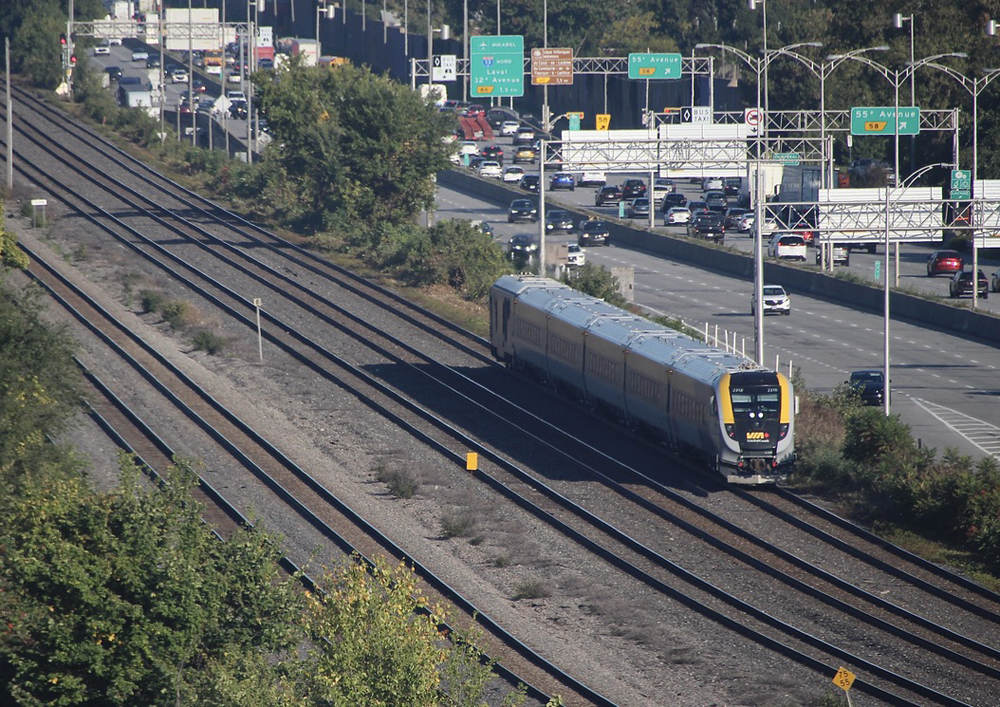
 www.trains.com
CN imposes axle-count restriction on VIA’s Venture trainsets (corrected) - Trains
MONTREAL — Apparently triggered by one or more incidents in which a VIA Rail Canada Venture trainset failed to activate highway crossing warning devices, Canadian National is now requiring that all of VIA’s Venture-equipped trainsets operate with 32 axles. The edict came late Friday, at the...