News   Jan 06, 2026
 278     0 
News   Jan 06, 2026
 327     0 
News   Jan 05, 2026
 664     0 

Richard Meier - A Modernist in White Armour

Another type of Skyscraper


After eight years of work, the Camden Medical Centre was finally opened in Singapore. This round tower was an interesting mix of recessed window ribbons and reverse taper, and that mix got mixed reviews. Below are several views of a 3D model, one with a fairly convincing backdrop. This is followed by two photographs of the completed structure, slightly distorted by the lens and further by the angle.

Richard Meier's Camden Medical Center
1990-98
Republik Singapura


Photographs of three-dimensional model
Camden%20Medical%20Centre.JPG

(© Richard Meier & Partners)

singa3.JPG
singa2.JPG
singa1.JPG


Exterior Views of Completed Building (with several changes from the model, mostly minor)
front.JPG
other.JPG
.​

 
Last edited:
Meier's High!


One of Richard Meier's earlier refinements to his museum designs, prior to Getty Center project, was High Museum in Atlanta. No, it was not a tribute to drug paraphernalia, it was named after its major sponsor - Harriet High:

Richard Meier's High Museum of Art
1980-83
Atlanta, Georgia USA


High%20Museum.jpg
GA-High.jpg
500x500_5e1df7b69dd6026d372f4e45b932f1ab.jpg

(© Richard Meier & Partners)

rampent.jpg
detfmsidedgm.jpg

(© Bluffton University / Douglas Miller)​

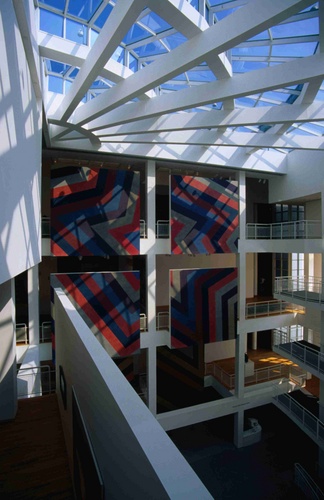
The extended ramp is a symbolic gesture reaching out to the street and city, and a foil to the interior ramp which is the building's chief formal and circulatory element. At the end of the ramp is the main entry and reception area, from which one passes into the four-story atrium. The light-filled atrium space is inspired by, and a commentary on, the central space of the Guggenheim Museum. As in the Guggenheim, the ramp system mediates between the central space and the art itself. In the Guggenheim, however, the ramp doubles as a gallery; in Atlanta, the separation of circulation and gallery space allows the central space to govern the system of movement. This separation also allows the atrium walls to have windows which admit natural light and offer framed views of the city.

From the official website of Richard Meier & Partners (Bolding added)

 
Last edited:
I own the book "Richard Meier Houses". It's gorgeous, and it has led me to search out Meier buildings when I have been in the area. More than any other home illustrated in the book, I would like to some day tour the Douglas House in Harbor Springs, Michigan, (which you included in one of the first posts in this thread, Zephyr) or, more precisely, live in it.

I found the book second hand at that shop immediately to the east of World's Biggest Bookstore on Edward. It was in mint condition, and it was signed by the architect, to Ted Rogers.

42
 
I own the book "Richard Meier Houses". It's gorgeous, and it has led me to search out Meier buildings when I have been in the area. More than any other home illustrated in the book, I would like to some day tour the Douglas House ...

Needless to say, we share the same interest in Meier, and particularly this house. I shall use your post as an excuse to further detail it for others to see.
 
More on Douglas House - the 'Private Side' exterior


"So steep is the slope to the water that the house appears to have been dropped into the site, a machine-crafted object that has landed in a natural world. The dramatic dialogue between the whiteness of the house and the primary blues and greens of the water, trees, and sky allows the house not only to assert its own presence but to enhance, by contrast, the beauty of its natural environment as well."

— Richard Meier, Richard Meier, Architect, (New York: Oxford University Press, 1976)

We have already noted that the "front entrance" is seldom shown on either the Smith or the Douglas House. Further, that Meier prefers to call this side - the "private side" (or "private sector," if there are two or more sides involved). Why does he do that? Let's take two views of the Douglas House on the private side:

Private Side of Douglas House:
left is entrance via the "flying Bridge"; right is view from that bridge on the northeastern side


438409455_6e6d66a178.jpg
438409485_5aea1afa03.jpg

(© flickr / joe83ltu)​

There is no attempt to dress this side up. For Meier, this is a private side that is meant only for service and entry functions. The flying bridge, which is a vaguely Medieval phrasing, evokes the image of a moat and crossing into a protected castle.

 
Last edited:
More on Douglas House - the 'Public Sector' overview with focus on Roof Deck


Below is a black-and-white view of the public sector, photographed by the AIA. The house actually sits on a seamless pedestal, that is the same width and depth of the visible part of the structure. Those pipes you see are stainless steel, and are connected to a white box because they are flues to a fireplace that lies primarily within this white box.

863587392_631c2115b1.jpg

(© AIA)​

Please review the top of the building, above, As reference points, note that the roof deck has a single tubular bar for railing, and the tops of the flues ascend beyond that rail before terminating. With these references,you can easily transition to the closeup pictures that follows:

438409649_04780580dd.jpg
438409629_c9fa589d04.jpg
438415437_233bb7ebe8.jpg

(© flickr / joe83ltu)​

 
Last edited:
More on Douglas House - the 'Public Sector' exterior staircase


There are two sets of staircases - the interior staircase if you look at the prior post's overview picture is on the left side; the exterior staircase is on the opposite side. The staircases are deliberately placed on the edges of the structure to avoid any obstruction to Meier's directional viewing plan.

These photographs were made as the photographer came down the exterior staircase, two storeys starting at the top:


438417728_f4d34148f5.jpg
438411884_d951a3e648.jpg


438417708_2c66601082.jpg
438411864_68234d9abd.jpg

(© flickr / joe83ltu)​

 
Last edited:
More on Douglas House - the 'Public Sector' interior living area


Finally we have two views of the "void" from opposite directions:

438411906_6684740928.jpg
douglas2.jpg

(©: flickr / joe83ltu on left, k-NAP on right)​

The dining table cannot be seen, since it would be behind the wall on the landing. There is another level, but that could not be photographed due to restrictions. If you look carefully at the photo in which the sun screens are lowered, you will get a glimpse of the lower level, but not much more.

 
Last edited:
Richard Meier and 'The New York Five' - Part One


Ahead, I plan to leave three posts. What you will see is a severely abbreviated version of a larger essay that I composed some years back, without the included citations.

Five Architects who became ‘The New York Five’

In the late 1960s in New York City, the Museum of Modern Art (MoMA) brought together the work of five would-be Architects, all of whom had no particular uniformity, but were placed into the same ... circumstance. Looking back to this time, one prominent observer stated that all the Architects involved were “scarcely known,†but indicative of the success of the exhibit, they would collectively be known ... as “The New York Five.†This ... mis-labeled group, ...[has] since become a high-water mark in Architectural history, and for several reasons … To the extent that Architects are known to the ... public... , these five men were [still] fairly obscure, but within this group, at least three were in the process of ‘becoming’ ...

Richard Meier and Michael Graves ... were a mere three months apart in age, Graves was the elder … Meier was making a name for himself with Smith House, which was a seminal work in his early career. His signature ‘white style’ in ... homes began with that commission, but Meier had deeper roots invested in ‘white’ that went back to Le Corbusier. … Graves was not yet the ‘Post-Modernist’ we think of today, but rather a vaguely aligned ‘fellow traveler’ as ... (one person) disdainfully commented. … In 1964, Graves had established a practise in the same town as he taught – Princeton, New Jersey – but his ambition was greater than just the nearby community. … Money was a strong motivator for Graves, it led to a change in style to attract future patrons, this was the beginning of a pattern for him over the next decade. ...

{The third} was the brilliant Peter Eisenman, the budding Neo-Deconstructivist, who was known more for his theories about architecture than his actual work in architecture. Eisenman published frequently in professional journals, and occasionally outside them, with his elaborate interior designs that were often left unrealised apart from the image in print. Eisenman was on a path that few dared to explore ... he went so far as to state that exteriors themselves were secondary ... "These (Eisenman interiors) look more like Escher prints than architectural spaces," according to one [observer]. ...

The remaining two of The New York Five – Charles Gwathmey and John Hejduk – were not only lesser known, but if one were to inspect the publications of that period, their names were sometimes left out entirely from The New York Five … There were instances where Gwathmey’s models are confused with Hejduk ... Of the two, Gwathmey emerged, over time, as the much talked about talent behind Siegel + Gwathmey; Hejduk, on the other hand, became more a teacher than an Architect ... and he lapsed into obscurity.

In 1972, a small book with the simple title of Five Architects, was ... published. Materials were specifically drawn from the exhibition at MoMA. … It was a poorly designed book with ... an unpolished look. First editions of this book, resembled mimeographed assemblages found in Universities for "internal use only." … A close friend of Meier, the English-born Colin F. Rowe … Architecture Professor at Cornell, was in this period, the 'Modernist' counterpart to Vincent J. Scully, the Art and Architecture Professor at Yale. Rowe eventually wrote what some called one of the more “uninspired†introductions to an important book …

Rowe published infrequently, but his influence was widespread ... He eventually abandoned the Modernist cause, and with his abandonment, the friendship he had with Meier faded noticeably. ...


Last edited:
Meier's Self-Admitted 'Transitional' Home: Rachovsky 1 of 2


The white house (is there any other kind?) that Meier designed for Howard Rachofsky sits on a dark granite podium. The landscape consists of a pool made to look like an abstract pond and grass that is raised and lowered in squares and rectangles. Inside are standard Meier staircases, but then there is also a floating spiral staircase that surrounds a supporting post. There is a bridge on the second floor where the low-profile railing is covered with transluscent frosted glass that suggests a Far Eastern screen divider. The bathroom is the starkest of any he has created - white on white with white silver faucets (since changed).


Richard Meier's Rachofsky House
1991-96
Dallas, Texas USA


Exterior

mrrp01.jpg
mrrp02.jpg

1482852959_c3d3db7748.jpg
887293441_d0370f60b5.jpg
1083492689_d34bc0a344.jpg

(©: flickr / fran1825; geocities; Richard Meier & Partners; and where noted on the photograph)

 
Last edited:
Meier's Self-Admitted 'Transitional' Home: Rachovsky 2 of 2


Interior

mrrp04.jpg
519986394_b9a78f51b3.jpg


519988766_6a34bcf4bb.jpg


519988254_49bc354c9b.jpg
519988930_cd575077cb.jpg


(©: flickr / Hila Ben Avraham; geocities; Richard Meier & Partners; and where noted on the photograph)

 
Last edited:
Richard Meier and 'The New York Five' - Part Two


"Architects can no longer afford to be intimidated by the puritanically moral language of orthodox modern architecture. I like elements which are hybrid rather than 'pure,' compromising rather than 'clean,' distorted rather than 'straightforward,' ambiguous ... and equivocal rather than direct and clear. I am for messy vitality over obvious unity ... I am for richness of meaning rather than clarity of meaning."

Robert Venturi


Meier vs. Stern - The Great Divide begins

One year later in 1973, Five On Five became the book that directly challenged Five Architects. This was the beginning of the ‘Post Modernist versus Modernist Debate' – Grays versus Whites – that took place across several venues from print to live-discussion. If Richard Meier could be considered the reluctant lead of The New York Five, Robert Stern seized the lead of the opposition. None of this occurred in isolation... in the critical period prior to Five On Five, in which the battle took form, there were several indications of a coming break...

Meier and Stern had known each other ... before. Just after he received his Master of Architecture degree from YSOA, Stern was hired by Meier to work as a designer at his fledgling firm. … Ultimately, Stern’s tenure was brief, but one can speculate that Stern had been predisposed to be at odds with Meier’s views prior to coming to Meier’s firm.

While at Yale, … Stern … attended several classes that exposed him to a different way of thinking. … The venerable (Art and Architecture Historian Vincent J.)... Scully, provided (him) … with a thoroughly acceptable raison d’etre for questioning the dominant ‘International Style’. … Scully often compared and contrasted Frank Lloyd Wright to Mies van der Rohe and Le Corbusier from the main European schools that made-up the International Style. … Stern appeared to have listened carefully based on his reminiscing about his years at Yale. ... Stern was also aware of Robert Venturi's musings on the role of history and imperfection versus the quest for rules and pure form that characterised the European Architects of that loosely labeled ‘style’... This was apparently interpreted then and later as a rigid approach to Architecture by this growing American school of interpretation …

Meier’s words and imagery in this period could have been drawn directly from Le Corbusier’s Vers une Architecture (...Towards An Architecture) - meaning in this case a new type of Architecture - published back in 1923. Like the great man himself, Meier used such equivalents as: role of light in defining space, the use of contour and surface as the latter two related to perception of mass... Above all, Meier declared that decorative ‘appliqués’ were out in his firm. … Stern was not amused by these positions, as evidenced by what he communicated to his friends at that time … Stern refuses to speak publicly on these matters today ...

Who were the authors of Five On Five? …. Like the "big three" of the Five Architects, there was a corresponding big three within the Five On Five: Robert Stern, Charles Moore and Jaquelin T. Robertson. Of these latter three, Robert Stern was the most formidable in the debate format. …

The man that labeled them ‘The New York Five,’ according to Meier, was New York Times Architecture critic Paul Goldberger. … Goldberger became a friend of both Meier and Stern, finding himself in the middle of the debates between the so-called Modernists and Post Modernists; he was often uncomfortable with both. …

Another who was in the middle was Philip C. Johnson. Johnson practised on both sides of the debate in his career, and was torn between his positions and his genuine desire to befriend, what he called “my kidsâ€. ... Stern and Meier, who were on starkly opposite sides, did not seem bothered by Johnson’s 'flip-flops,' nor did Johnson become an enemy when he suddenly appeared on the other side of Meier or Stern. … A darker side to Johnson was his anti-Semitism. ... Both Meier and Stern were Jewish, and were well aware of Johnson’s views, but neither outwardly challenged him nor distance themselves – it was a curious acceptance of the aging Johnson as a product of his times, although it certainly was not an excuse …


"American architecture is going all over the place, like pellets sprayed from a shotgun. ... You cannot evoke the past by simply taking historical symbols ... What does it mean to put a Roman arch over someone's house in Connecticut? Nothing. Architecture has to do with the totality of the building, not the application of illiterately assembled elements."

Richard Meier (2)

 
Last edited:
Homage Series - Introduction


We deliberately began this thread with a photograph of Le Corbusier's Villa Savoye, and that was juxtaposed to Meier's Smith House. Villa Savoye, however, is not the home that influenced Meier the most, it is rather the home that illustrates perhaps the best of all Le Corbusier's purist structures. For Meier, I feel the better example would have been Villa de Monzie / Stein, which will start out the homage series in the next post.

LeCorbusier.jpg

Coutesy Architecture in the Bay Area​

We will then fast forward all the way to the end of Le Corbusier's career to a building he designed but never saw completed - Sainte Pierre Church in Firminy, France. Richard Meier paid homage to this building twice, but especially in his Federal Building and United States Courthouse in Islip, New York, that was completed in 2000. This is a type of homage rarely seen in that it seems unconnected to the style of the building to which it is attached.

meier.jpg

© Richard Schulman Photography / photo Esto.com​

I will take the time to point out selective ideas, details and perspectives that Meier derived from Le Corbusier, if time and space permit. This was not unexamined tracing of the master, but a reworking and returning to themes that informed Meier's entire career.

 
Last edited:
Homage A - Le Corbusier's Villa de Monzie / Stein (Exterior Walls)


The French Minister of Culture and Education, Anatole de Monzie, contracted Le Corbusier initially to build a villa in the town that was then known as Garches. By the time it was completed, the French Minister was divorced and living elsewhere, and his former wife with child were sharing the building with the Stein family. Michael Stein was the brother of the famed Gertrude Stein in New York, and both he and his wife were collectors/resellers of artwork, with a particular bent toward Matisse.

Interestingly enough, the Villa de Monzie / Stein was specifically designed to be two separate homes - one home on one side, the other home on the reverse side - yet, despite this there would be a common overall structure with a few key common areas that were only visible internally. The way it was referred to at this time was "double home."


Le Corbusier's Villa de Monzie / Stein

(aka Villa de Monzie initially;
then Villa Stein-de Monzie or Villa Garches;
and eventually Villa Stein)

1926-27
Vaucresson (Garches), France​

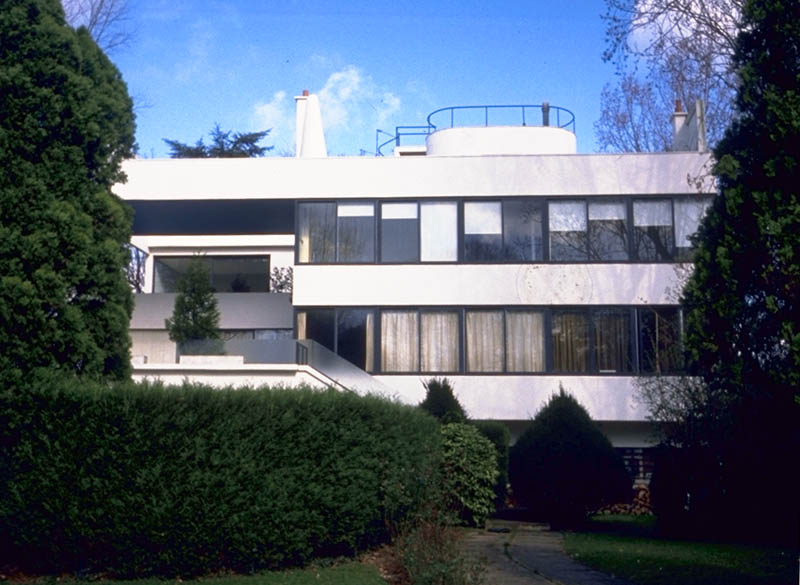
Top Left - Front View / Top Right - Exploded Sketch of the Exterior Walls of the Two Homes / Bottom - Rear or Garden View

MH088160-p.jpg
333_07.jpg
C27T5.JPG

© NAOCE, SJTU; AGRAM; portalVitruvius / Ronaldo de Azambuja STRÖHER


Unlike Villa Savoye, Villa de Monzie / Stein distinctly differs from one main side to the other. The function of this division was to give each family a different look on the one hand, and to address the issues of the lot on the other.

In Richard Meier's reinterpretation, this difference was realigned into the Private versus the Public Side or Sector for one family - the Private Side/Sector, typically uses narrower window ribbons elevated on the interior for privacy, but admitting some light, and can be greatly tinted; the Public Side or Sector having the greater use of clear glass, and facing toward the sun in a particular way to allow the light to travel across the plane in a dramatic but controlled manner.

Note also the door with the cabled awning. It is signature Le Corbusier. Although he didn't invent it, he popularised it in many of his purist buildings before WWII. Meier also uses this door, but mostly on his non-residential structures.

Finally note the balcony treatment - sometimes referred to as the Le Corbusier 'cabinet drawer balcony' in the 1930s. Meier again uses this idea, but he updates the shape and sometimes inserts frosted glass.


Last edited:

Back
Top