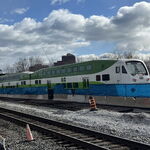


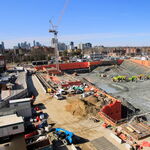


just east of the creek
Senior Member
Not much of a service aspect to that decision when they are less than 20 km (?) from Union.The crew ran through a rule 42/work block, and needed to be relieved from service.
Dan
|
|
|
Not much of a service aspect to that decision when they are less than 20 km (?) from Union.The crew ran through a rule 42/work block, and needed to be relieved from service.
Dan
Not much of a service aspect to that decision when they are less than 20 km (?) from Union.

The other thing to consider here is.....When construction or maintenance crews are working on or close to the tracks, they are protected by “Rule 42” authority, which consists of written instructions to every train outlining where the worrk zone is located. The zone where the work crew has authority to work is marked by flags (metal signs, actually) placed on the tracks. Trains must contact a Foreman who controls movement through the work zone for authority to pass the red flag marking the zone. The Foreman confirms that everyone is clear of the track and that it is safe to pass through the work zone. Until this permission is received, the train has no authority tto proceed and must stop and await clearance from the Foreman.
The point is, this form of protection is entirely manual, with no mechanical backup. The signal system may display proceed indications, but the crew must remember that the work zone is there, must watch for the flags, and must follow the rule book to work with the Foreman.
What can go wrong involves not just the train crew but the Foreman and the written instructions and documentation, and/or the placement and visibility of the flags. So it is important to not just assume that the crew was at fault here. The events and facts have to be determined in some detail before any conclusions are reached. That’s why the crew is taken out of service - and it’s why I would discourage any speculation here on UT. So far, all we know is that an event happened.
- Paul

Ouch... that's very serious... not gonna speculate anything, though i do know who the forman was for those particular limits but a rule 42 violation is as serious as a rule 439 violationThe crew ran through a rule 42/work block, and needed to be relieved from service.
Dan

If they can run trains every 3 hours then why don't they? It would help with the overcrowding.Some general references to infrastructure improvements needed.

They do run every 3h to Kitchener on weekdays, just not weekends. I expect they will also run all day to Kitchener on weekends as well once they have enough crews.If they can run trains every 3 hours then why don't they? It would help with the overcrowding.
Or are some standby busses? Or is excess OT an issue?
They do run every 3h to Kitchener on weekdays, just not weekends. I expect they will also run all day to Kitchener on weekends as well once they have enough crews.

They'll continue blaming CN but the yesterday's price is not today's price...On weekdays - After the morning peak service to Toronto (6 trains) there are four GO trains departing Kitchener, at 08:45, 11:45, 14:45, and 20:45. GO trains arrive in Kitchener at 11:21, 14:21, 17:21, then four rush hour trains up to 19:51, and then at 23:21.
That's a significant level of service, but adding any more is unlikely until a great deal of track is added. One wonders what is holding up finalisation of procurement let alone shovels in the ground. The 2-way hourly service plan is well and truly overdue.
- Paul
Yeah I'm not sure what the holdup is in Acton and Georgetown but there are already shovels in the ground in Breslau and Guelph so it may be best to not have trains on weekends until construction is finished, so that it progresses as quickly as possible.On weekdays - After the morning peak service to Toronto (6 trains) there are four GO trains departing Kitchener, at 08:45, 11:45, 14:45, and 20:45. GO trains arrive in Kitchener at 11:21, 14:21, 17:21, then four rush hour trains up to 19:51, and then at 23:21.
That's a significant level of service, but adding any more is unlikely until a great deal of track is added. One wonders what is holding up finalisation of procurement let alone shovels in the ground. The 2-way hourly service plan is well and truly overdue.

I'd vote for "Speed River".No photos yet... but the dual control switch at Guelph GO and Control location light is now up but not activated... probably control location name will be Guelph but thats to be determined.