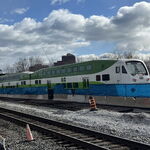
Historical awareness is beneficial if it goes beyond “trains used to take less than 4 hours between Toronto and Montreal”, but becomes a liability when it omits the parts where sub-4h travel times were only achieved by a single daily token Express train during one single month in 1967 and again for two periods in the 1990s and 2000s. Which was exactly what I already explained to you 3 years ago:
I know the schedule - I very regularly used the train during the 1980s (when 4.5 hours was achievable) and the 1990s, and am well aware that less than 4 hours was achieved relatively recently for the best part of two decades around the turn of the century. Travelling nowadays seems like a step back in many ways.
What can be done in the past can be done again, with relatively cheap regulatory changes. If they can run one train under 4 hours a day, they can run 10 under 4 hours with proper regulation of CN and relatively less significant infrastructure improvement, such as longer sidings, and stretches of third track.
I also mentioned 3 years ago, that it seems unlikely that they can achieve under 4 hours with the HFR route - let alone improve on it - and playing with GO trains all the way from Toronto to Agincourt is only going to make things worse.
The
travel times implied by the RFEOI are so aggressive that they won’t be possible without substantial realignments and large stretches of grade separations (580 km divided by 4h13 equals an average speed of 138 km/h or 78% of 177 km/h, i.e. the legal barrier of sound for operating with at-grade crossings. Either ambitions will have to be scaled down or the scope will creep up drastically and escalate capital costs towards HSR territory.
If they have the project well defined, for achieving, say, a 4-hour run time from Toronto to Montreal, then scope creep shouldn't be too significant. I think "ambitions scaled down" is going to be the keywords for this project. And we've already seen this with the time-losing alignment change in Toronto - where perhaps the biggest issue isn't the slightly longer route - but being stuck behind GO trains - particularly from St. Clair to Sheppard where there's only going to be two tracks. In Montreal, the decision not to have VIA use the tunnel will result in Montreal to Quebec City trains backtracking all the way to Lachine (or have they found a way to get onto the Adirondack subdivision - which would still take them through CSL.
2) At which GO station will three different rail transit lines meet by the end of this year?
There's been 3 meeting there at Kennedy for years. The Line 5 opening has though been delayed until next year; it's not clear whether that happens before of after the permanent closure of Line 3 in fall 2023. Line 7 will also likely terminate there, but that could easily be mid 2030s or later (if ever) the way the city is dragging their feet.
So yes, a VIA stop at Kennedy is in some-ways a no-brainer - at least from a transit perspective. BUT, it's not really comparable to suburban stops like Oshawa, Oakville, and Dorval - which primarily cater to automobiles and not transit.
Agincourt is the first location the line intersects a major highway - though it's ugly traffic around there already; but there'd be a subway station there. I'm not sure anything else makes sense until Locust Hill station.
I'm not sure there's any really great car-accessible locations. So no doubt it would be Kennedy if HFR or a Peterborough service is done.