News   Apr 02, 2026
 1.3K     1 
News   Apr 02, 2026
 792     0 
News   Apr 02, 2026
 2K     2 

VIA Rail

I only see any chance of this happening if Ford really goes ahead with refurbishing Detroit's Michigan Central Station with all the border facilities needed to clear US and Canadian customs. And even then, I only see existing VIA trains extended to Detroit, where passengers would clear customs before boarding / after detraining a VIA train in Detroit.

Since it is Amtrak, not VIA, that has negotiated a deal with CP to use their tunnel, I see a more likely option would be for Amtrak to extend some of their trains to Windsor with pre-clearance facilities being built there (similar to Vancouver and Montreal).

In order to allow for sufficient time to clear customs (and account for delayed inbound trains) a transfer time of 90-120 minutes seems desirable. If we look at the pre-Covid schedules (and assume that VIA trains still serve the station in Walkerville, with a 15 minute dwell time and a 45 minute travel time onwards to Detroit), this would result in a transfer time of 3 hours Eastbound, but 6 hours Westbound:

View attachment 376412

Not that easy to schedule convenient connections in Detroit with only three trains operating to Chicago, but I believe I read that Amtrak wants to increase that to six round-trips, which should provide for much more flexibility...

This extension would certainly be dependant on Amtrak significantly improving their service (in both speed and frequency) between Chicago and Detroit (and maybe HFR west as well). It would also require VIA and Amtrak to work together to co-ordinate their schedules. All of this will take time and it certainly won't happen overnight.
 
If we have any intention of connecting the Canadian and American passenger networks across the Ontario/Michigan border, then a customs station at Michigan Central is (from what I can tell) the only reasonable path forward. Of course it would be more ideal for Chicago-Toronto passengers to have a customs facility in Toronto, with a single-seat ride seamlessly crossing the border, but doing so would also require customs facilities at any Canadian station at which the train stops. That is a good longer term goal, but even then the first step would still be to build a customs facility in Detroit to serve all of the communities between Toronto and Detroit skipped by Amtrak's through service. If we only build a customs facility in Toronto, then everyone in southwestern Ontario would need to backtrack to Toronto to cross the border, which of course hardly anyone would do. The number of passengers lost west of Toronto could easily exceed the number of passengers to/from Toronto who are dissuaded by the travel times at the border.

The key factor which makes the Detroit hub concept more palatable than some other en-route transfers is that most passengers would want to disembark in Detroit regardless, either to go to/from Detroit, or to transfer to another service such as the existing train service to Pontiac, the planned commuter service to Ann Arbor, and the proposed Amtrak service to Cleveland via Toledo.

Conceptual services from Michigan Central station.
- I transfered the existing Pontiac Amtrak service to the future Michigan commuter rail agency, to allow through-running from Ann Arbor to Pontiac serving both of Detroit's central stations.

Capture0.JPG


The primary goal stated in the above article is not to create a Chicago-Toronto rail connection, it is to create a Detroit-Toronto rail connection, with the through-traffic from other American cities being a modest bonus. The US is already planning to increase service between Chicago and Detroit, and putting Detroit on the VIA map would allow them to increase Detroit/Windsor - Toronto service too, regardless of any through passengers from Chicago.

a) the customs process, as noted, is problemmatic.
b) even with reconstruction, at best the approach to both Windsor and Detroit, and the passage between these termini, will be slow speed -this plus customs layover will make for slow trip times
Lastly, I do not share other posters acceptance of the hub design, here and elsewhere. I agree that it permits greater operational reliability… but that’s strictly cosmetic. Dwell time is toxic to the passenger experience. If I’m going to cool my heels somewhere for 90 minutes, I might as well do it in an airport where there are more amenities.
A service with connections in Detroit will certainly not be very fast, but neither are the alternatives. Wait times at the roadway bridges are often long and unpredictable, and plane passengers also need line up to clear customs. Both of those delays would tend to be well under the 90 minutes likely to be scheduled for a transfer in Detroit, but much of that time could be spent wandering around the new amenities at Michigan Central, which will include shopping and parks.

c) much of the investment needed in track etc is in Canada, and while Amtrak may have capital at the moment, it’s unlikely that it would be allowed to spend it on this side of the border, and there is no sign that Ottawa is willing to fund on this side….hence the hint that Ontario might have to do so
Indeed Canada needs to be fully on board to make this happen, primarily to upgrade the Essex Terminal trackage for passenger use. However, the US could fund most or even all of the capital work to reactivate Michigan Central Station and build a customs facility.

d) a single train per day looks nice on the map, but as a matter of modal share it’s only a cosmetic victory.… a single Dash-8 carries as many people.
If we do decide to go through with upgrading the Essex Terminal trackage, we should indeed aim for a lot more than just a single connection per day. Perhaps one train per day could run non-stop from Detroit to London to avoid the reverse move, but other trains should also be extended across the border.

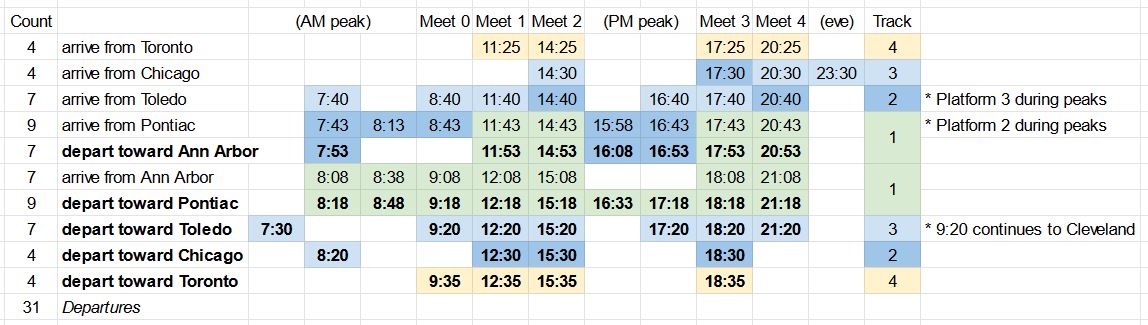
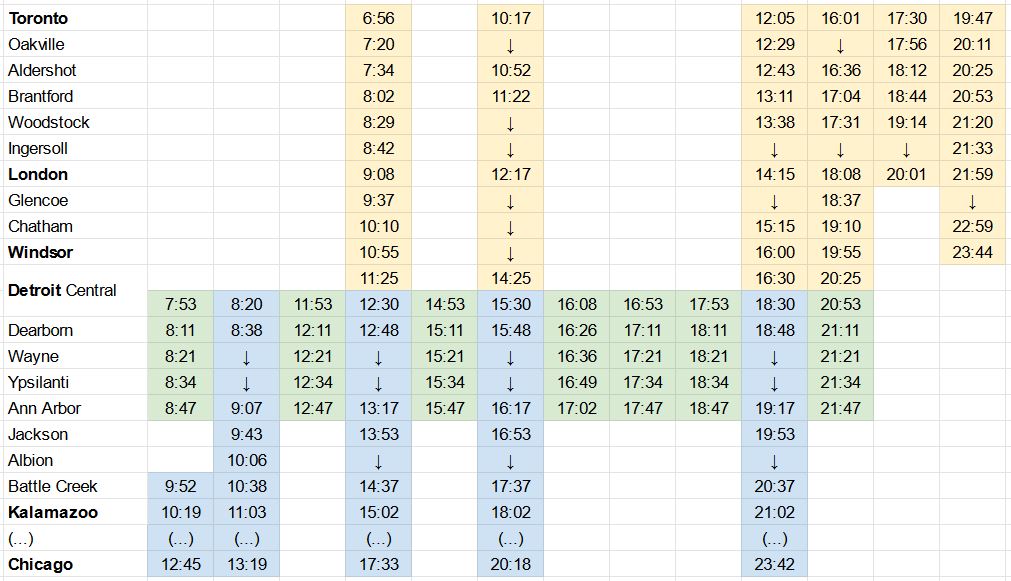
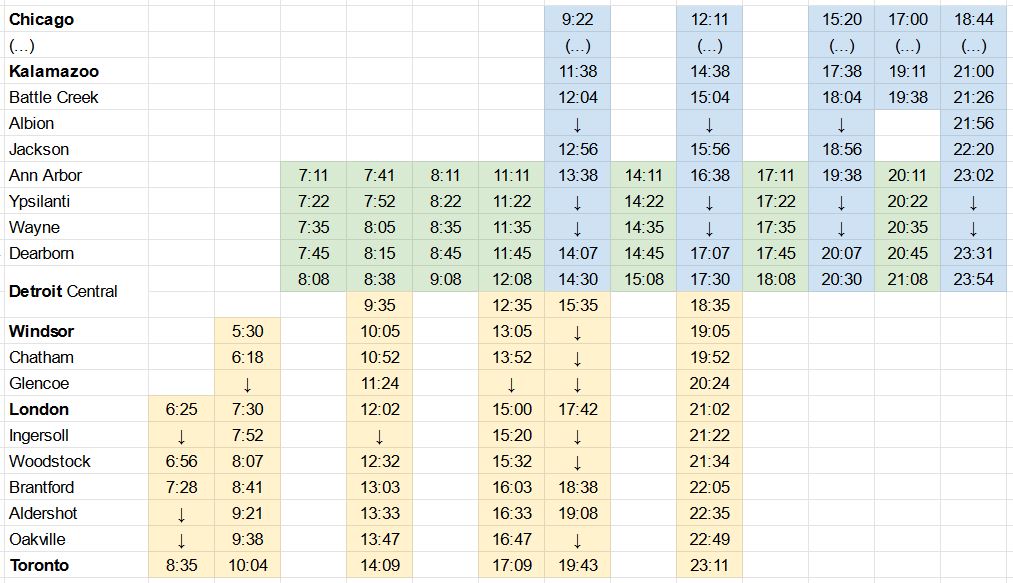
Here's a vision of how a relatively modest service level on both sides of the border could massively increase cross-border connectivity. The idea is that every 3 hours there would be a timed meet, where all or most of the lines would arrive and dwell, facilitating transfers. To allow time to clear customs, the VIA train would be first to arrive, and last to leave.

I assumed 4 platforms in service, because Ford has stated that they are protecting the 4 southern platforms for passenger rail operations. This is rather underwhelming - I would have wanted at least 5 platforms to enable growth for the 5 services serving the station.

1643045531592.png


The below timetables are purely to illustrate the concept for timed meets, and the times of day at which they might occur. Any of these time slots may actually be occupied by other train movements and/or not be approved by the host railway. Travel times between Detroit and Windsor are also significantly reduced compared to current trackage.
I made these fantasy timetables a while ago and am not entirely satisfied with them, the dwell time for VIA should be much higher to provide a larger margin of error for passengers transferring through customs.
Capture4.JPG

Capture3.JPG

Capture2.JPG

If the passage to Detroit could become a 15-minute addition to current VIA schedules, then one could easily run three trains a day each way and have a much greater market penetration. Extend those train even part way across Michigan, and that market share can become even higher…. whereas, while the Ford reno will be fantastic, I can’t see many people driving to Ford and parking their cars for even a day trip. While Detroit is on the road to recovery, the siting of Ford as a terminal is unproven for today’s travellers… Detroit/Southern Michigan is still an autocentric metropolis, downtown Detroit is still intimidationg, and will be for a long time.
The station access in Detroit is certainly an important consideration. In addition to looking into options such as extending the streetcar along Michigan Ave to the station, it's worth noting that people also have the option of taking a taxi/ridershare to the station. The cost of those services makes them impractical for access to regional stations (*cough* London at 05:20 *cough*) but even Americans are accustomed to travelling to a car-centric wasteland (a.k.a. airport) without using their own personal vehicles, as part of a long-distance trip.

We should be fixing Niagara Falls and then using it as a model for other through services, not declaring defeat and propagating a bad model. Changing trains, especially crowded trains, is a losing proposition for the customer… a reliable service that doesn’t attract riders is no victory..
Given that so many passengers will be embarking/disembarking at Detroit regardless of how the customs is set up, I would argue that Detroit is actually is a more promising place to demonstrate an international rail terminal than Niagara Falls. Niagara could then use Detroit as a model.
 
Last edited:
Here's a vision of how a relatively modest service level on both sides of the border could massively increase cross-border connectivity. The idea is that every 3 hours there would be a timed meet, where all or most of the lines would arrive and dwell, facilitating transfers. To allow time to clear customs, the VIA train would be first to arrive, and last to leave.

I assumed 4 platforms in service, because Ford has stated that they are protecting the 4 southern platforms for passenger rail operations. This is rather underwhelming - I would have wanted at least 5 platforms to enable growth for the 5 services serving the station.

View attachment 376511
We're veering well into the hypothetical here, but...

Keep in mind that at this time only one of the two bores of the tunnel is being used - the northerly one.

I don't know what the condition of the southern bore is right now (I don't believe that it has been used since the early 1990s), but it seems to me that barring any major structural issues it would make more sense to dedicate it to any hypothetical cross-border VIA service as its clearances have not been raised like they have on the northern bore. And considering the proximity of the tunnel entrance to the station, therefore it would make more sense to me to have a separate platform (or platforms) on the south side of the mainline dedicated to this hypothetical cross-border service. Doing so would allow for more freedom of scheduling with the freights, as they wouldn't be directly interfacing with them as much.

Dan
 
^One nit to pick.... the Pontiac route is not really a separate "service" but just an extension of the Chicago trains. To me this is indicative that Detroiters don't have much of a habit of coming downtown for a train (...yet...) it's more like VIA customers using the former through trains that offered stops at Oshawa, Union, and Aldershot.

It's possible to theorise a service that uses Ford as the central terminal, but it really isn't as yet.

But that does suggest that a VIA train would need to terminate at Detroit and through passengers would transfer.

- Paul
 
We're veering well into the hypothetical here, but...

Keep in mind that at this time only one of the two bores of the tunnel is being used - the northerly one.

I don't know what the condition of the southern bore is right now (I don't believe that it has been used since the early 1990s), but it seems to me that barring any major structural issues it would make more sense to dedicate it to any hypothetical cross-border VIA service as its clearances have not been raised like they have on the northern bore. And considering the proximity of the tunnel entrance to the station, therefore it would make more sense to me to have a separate platform (or platforms) on the south side of the mainline dedicated to this hypothetical cross-border service. Doing so would allow for more freedom of scheduling with the freights, as they wouldn't be directly interfacing with them as much.

Dan

Interesting. Even if they did build a separate platform on the south side of Michigan Central, the passenger trains would still need to cross over the tracks to get to Windsor's Train Station. Another theoretical option is that CP is hoping to get money from Amtrak to refurbish (and enlarge) the southerly bore to increase capacity so that Amtrak can use the tunnel. Then, even if the northerly bore was reserved exclusively for passenger use during the day (probably not necessary), CP would still see an increase in capacity since they could use both bores at night.

Why would they only use one tunnel? Is there not enough demand for both tunnels to be used?

If as @smallspy suggests. it hasn't been enlarged for double stacks and autoracks, it may not have been worth the cost of enlarging it, but if they can get Amtrak to pay for it...
 
Why would they only use one tunnel? Is there not enough demand for both tunnels to be used?
Two reasons - one, traffic levels aren't high enough to require the use of both tracks. And the second, only the northern bore has been enlarged to handle larger rolling stock, largely due to the first.

Interesting. Even if they did build a separate platform on the south side of Michigan Central, the passenger trains would still need to cross over the tracks to get to Windsor's Train Station. Another theoretical option is that CP is hoping to get money from Amtrak to refurbish (and enlarge) the southerly bore to increase capacity so that Amtrak can use the tunnel. Then, even if the northerly bore was reserved exclusively for passenger use during the day (probably not necessary), CP would still see an increase in capacity since they could use both bores at night.
Well, maybe this is the second part of the hypothetical....

Why remain at Walkerville?

VIA has made mention of using the CP tracks for many years to access Windsor, as they are a little bit closer to downtown than the former CN station was. (I don't know why, it'd never seemed that much further to me.) CP currently crosses the Chatham Sub at Ringold at grade, and at a fairly oblique angle, meaning that a connection track would not be hard to add, and it could even be done as a reasonably high-speed connection.

Dan
 
Two reasons - one, traffic levels aren't high enough to require the use of both tracks. And the second, only the northern bore has been enlarged to handle larger rolling stock, largely due to the first.


Well, maybe this is the second part of the hypothetical....

Why remain at Walkerville?

VIA has made mention of using the CP tracks for many years to access Windsor, as they are a little bit closer to downtown than the former CN station was. (I don't know why, it'd never seemed that much further to me.) CP currently crosses the Chatham Sub at Ringold at grade, and at a fairly oblique angle, meaning that a connection track would not be hard to add, and it could even be done as a reasonably high-speed connection.

Dan
Could you not build a track facing the station at the WYE?

1643134098213.png
 
Could you not build a track facing the station at the WYE?

View attachment 376713

The way I see it there are three ways for VIA to get to Detroit:
  1. Build a wye as you proposed.
  2. Not bother with the wye and back in/out of the station when going from/to Detroit.
  3. Bypass the station in Windsor (possibly building a new station) and use CP's Windsor Sub west of the junction with VIA's Chatham Sub, as @smallspy suggested.
Each has its own advantages and disadvantages.
 
The way I see it there are three ways for VIA to get to Detroit:
  1. Build a wye as you proposed.
  2. Not bother with the wye and back in/out of the station when going from/to Detroit.
  3. Bypass the station in Windsor (possibly building a new station) and use CP's Windsor Sub west of the junction with VIA's Chatham Sub, as @smallspy suggested.
Each has its own advantages and disadvantages.
Not serving Windsor would defeat the purpose.
 
Well, maybe this is the second part of the hypothetical....

Why remain at Walkerville?

VIA has made mention of using the CP tracks for many years to access Windsor, as they are a little bit closer to downtown than the former CN station was. (I don't know why, it'd never seemed that much further to me.) CP currently crosses the Chatham Sub at Ringold at grade, and at a fairly oblique angle, meaning that a connection track would not be hard to add, and it could even be done as a reasonably high-speed connection.
The City of Windsor and Transport Canada did a "Community Based Strategic Rail Study" in 2008. Several options revolved around relocation of VIA to the CP, removal of the Chatham west of Ringold in favour of using the Windsor Sub, or a dogleg onto the CASO sub (or further, removing CASO sub too!)

Study can be found on this page: https://www.citywindsor.ca/resident.../transportation-studies,-eas-and-reports.aspx
Press write-up: https://www.pressreader.com/canada/windsor-star/20081028/281560876624764
 
The way I see it there are three ways for VIA to get to Detroit:
  1. Build a wye as you proposed.
  2. Not bother with the wye and back in/out of the station when going from/to Detroit.
  3. Bypass the station in Windsor (possibly building a new station) and use CP's Windsor Sub west of the junction with VIA's Chatham Sub, as @smallspy suggested.
Each has its own advantages and disadvantages.
What would be the disadvantages of the wye?
 
What would be the disadvantages of the wye?

Possible land acquisition costs, plus the need to change ends at Windsor, plus more complext signalling.

For the short distance required, and assuming use of double ended VIA Siemens trainsets, backing out would be an acceptable alternative. Moving the depot might be in the same cost ballpark.

- Paul
 
Possible land acquisition costs, plus the need to change ends at Windsor, plus more complext signalling.

For the short distance required, and assuming use of double ended VIA Siemens trainsets, backing out would be an acceptable alternative. Moving the depot might be in the same cost ballpark.

- Paul
Moving Windsor station would cost the same as building a WYE?

And who's land are they going to build a station on? There are no buildings where the wye would be so why would that be so expensive?

You could ask CP to build it and they would recoup the costs through track fees.

The bigger issue is will ETR be cooperative to allowing passenger trains on their network and what it would cost to connect it to VIA or Amtrak CTC system.
 
You could ask CP to build it and they would recoup the costs through track fees.

The money VIA pays to the freight railways to use their tracks covers little more than the costs of having the trains on the tracks. Even if they make a bit of money from it, it will hurt their Profit Margin (which is a key performance indicator), as it isn't as profitable as moving freight. That is why the railways will often cut routes that are only slightly profitable and focus on the highly profitable ones.
 

Back
Top