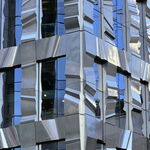
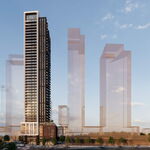
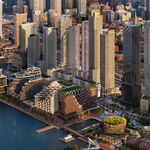
Rochon identifies several characteristics - a lantern effect at night, reverence for wood, use of horizontal screens, floating planes, surprise views of the outside, context of site, pinch/release at entranceways, play of surface textures and colours - that are part of the language of the style. I don't see them as being restricted to either high or low rise, commercial or residential.
The recently published, Substance over Spectacle - Contemporary Canadian Architecture includes the work of several Toronto firms, including four examples by aA. Here's part of what aA has to say:
"Housing makes cities. Theory's rediscovery of the city, and its reification of urbanism over the past three decades, has been inversely proportional to practice's involvement in mass housing. While residential construction constitutes over 80% of building activity in North America, this activity occurs beyond the purview of the salon.
The housing problem was once a fundamental project of the Modern Movement. Reeling from the failures of post-war urban renewal initiatives, and recently discredited as a valid policy issue by neo-liberalism, housing has been left to the vagaries of the market place. The hegemony of the development industry and the commodification of dwelling have silenced design culture. At the present moment, housing has lost its architectural cachet."
aA goes on to say, "We enjoy the scale, ambition and essential optimism of developers. In no small part, the general awfulness of our cities is due to the studied refusal of committed architects to involve themselves in their dreams."