News   Dec 12, 2025
 121     0 
News   Dec 11, 2025
 750     0 
News   Dec 11, 2025
 266     0 

Toronto Eglinton Line 5 | ?m | ?s | Metrolinx | Arcadis

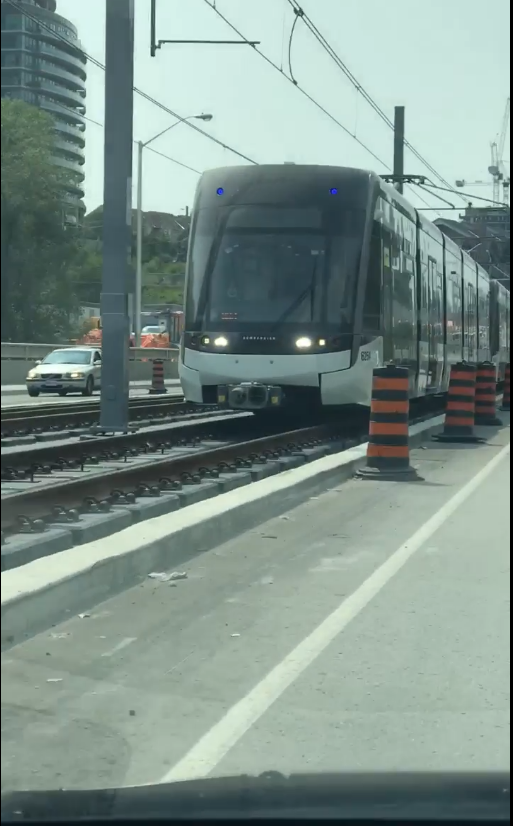
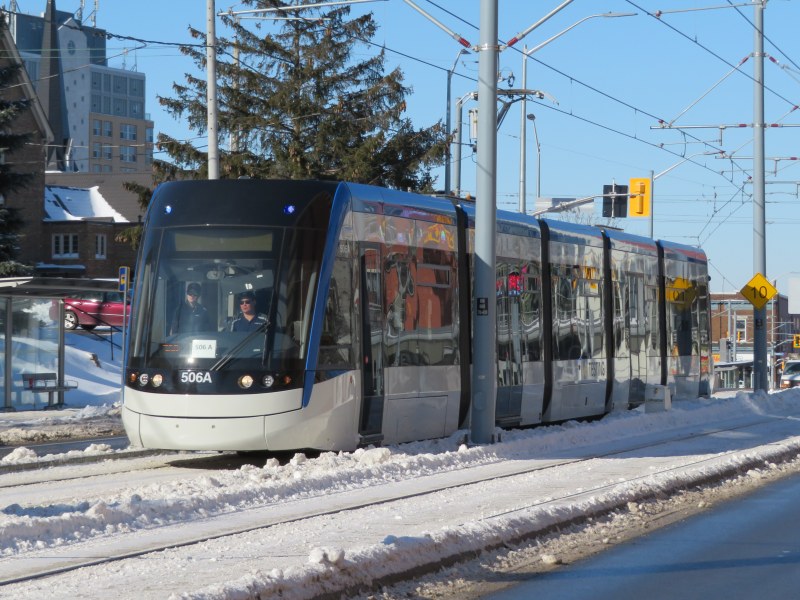
Crosstown Train out for an east-end sojourn.

1629506156043.png

Credit: Jim Lang

This is the bridge over the West Don River, just west of Leslie St.
 
^I'm confused why are the LRVs using the TTC's blue accessibility lights? Didnt Metrolinx' consultants tell them the LRVs are supposed to look like Toronto subway trains? Toronto's subway trains dont have blue accessibility lights.

Metrolinx please explain, i'm sure the logic makes oh so much sense but there's just something we are all just missing.
 
^I'm confused why are the LRVs using the TTC's blue accessibility lights? Didnt Metrolinx' consultants tell them the LRVs are supposed to look like Toronto subway trains? Toronto's subway trains dont have blue accessibility lights.

Metrolinx please explain, i'm sure the logic makes oh so much sense but there's just something we are all just missing.
lol, are you sure?

1629519736178.png
 
^I'm confused why are the LRVs using the TTC's blue accessibility lights? Didnt Metrolinx' consultants tell them the LRVs are supposed to look like Toronto subway trains? Toronto's subway trains dont have blue accessibility lights.

Metrolinx please explain, i'm sure the logic makes oh so much sense but there's just something we are all just missing.
Don't forget Metrolinx didn't change much on them from the original order that the city of Toronto had for them back when they were going to be used for transit city.
 
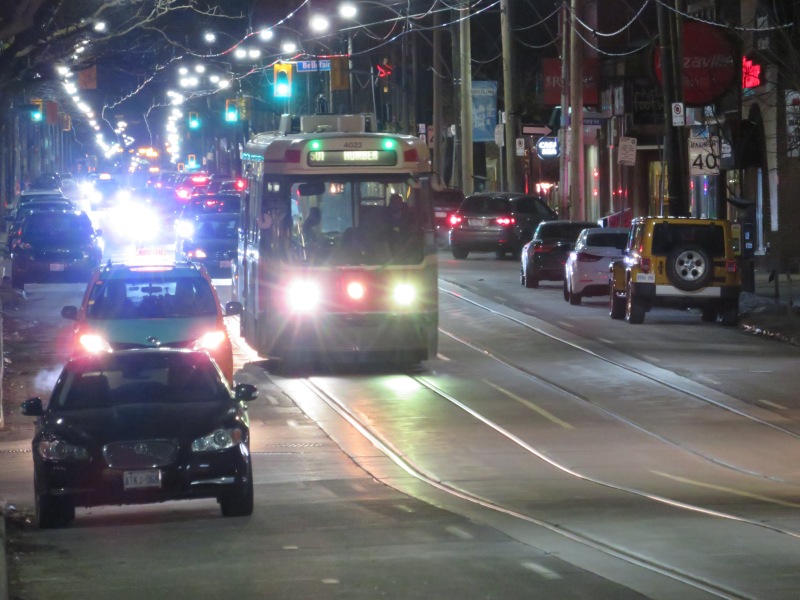
Personally, I find it easier to see the streetcars coming in the far distance with the blue lights, at a distance, I was never quite sure when the streetcar was 3 or 4 traffic lights away, if it was a streetcar coming, or just the traffic lights.
 
^The blue for accessibility had its day, but is a bit meaningless now that all transit vehicles are built to be accessible.

The blue is fine to spot a transit vehicle in the distance, but the traditionalist in me wishes for the old PCC green.

- Paula
 
^The blue for accessibility had its day, but is a bit meaningless now that all transit vehicles are built to be accessible.

The blue is fine to spot a transit vehicle in the distance, but the traditionalist in me wishes for the old PCC green.

- Paula
From link.

The story of Toronto’s streetcar “bull’s eyes”

In 1891, the Toronto Railway Company (TRC) was created, taking over the city’s streetcar system from its predecessor, the Toronto Street Railway. The TRC quickly began electrifying Toronto’s transit network, operating fifteen routes across the city. Electric streetcars were faster than horse-drawn trams, and passengers had difficulties figuring out which streetcar was theirs at night.

This was a problem as many streetcar routes overlapped. For example, Dupont and Avenue Road streetcars operated on Yonge Street south of Bloor, and Belt Line and Yonge streetcars both ran on Front Street. While the TRC had metal signs on the top and sides of each streetcar to denote the route, they weren’t illuminated. With electric light still in its infancy — arc lamps were too intense while early incandescent lamps were too dull to adequately illuminate route signs — the TRC developed an ingenious solution: uniquely coloured glass bulbs mounted on the roof, lit by interior lights. These lights became known as “bull’s eyes.”

Under this scheme, the Yonge Streetcar could be identified by one blue light, while the Broadview Streetcar could be identified with red and green lights. This system required passengers to memorize their route’s colours, and as new routes were introduced, changed, or withdrawn, it became cumbersome. Eventually, lighting technology caught up: while back-lit destination signs were possible by 1910, the TRC became hesitant to spend any capital funds to modernize its fleet or expand the streetcar railway network. The City of Toronto was forced to start its own streetcar system, the Toronto Civic Railway, to serve outlying neighbourhoods.

Though the Ontario Railway Board (predecessor to the Ontario Municipal Board) refused to force the TRC to expand the street railway network beyond the 1891 boundaries, it ordered the TRC to install backlit route signs. These new signs were introduced in February 1913, and those unique coloured bulbs disappeared by 1915. Six years later, the TRC’s franchise was up, and the city-owned Toronto Transportation Commission came into being.
In 1935, the TTC re-introduced “bull’s eyes” to its streetcar fleet. Officially known as an advance light, a single roof-mounted light, which gave off a blue-green hue, was designed to let waiting passengers know a streetcar was on its way. At the same time, the TTC installed dash lights, which both illuminated advertising cards and provided additional lighting, a useful safety feature.
img_7929-001.jpg

New PCC streetcars, which began arriving in 1938, were built with the advance lights already installed. By 1940, all streetcars, including the remaining wooden cars acquired from the Toronto Railway Company, were equipped with advance lights. After the Second World War, PCC streetcars purchased from cities such as Cincinnati, St. Louis, and Kansas City, were similarly fitted with the roof-mounted lamps.
img_8717-001.jpg

By the 1970s, the TTC decided to maintain its street railway fleet after planning for their eventual replacement with buses and subways, and sought a replacement fleet for its ageing PCCs. The new Canadian Light Rail Vehicles (CLRVs) and Articulated Light Rail Vehicles (ALRVs) were designed with dual advance lamps, mounted within the streetcar body, immediately above the destination sign.

Advance lights were introduced to TTC buses starting in the mid-1990s, as new wheelchair-accessible vehicles were added to the fleet, starting with high-floor Orion V and Nova RTS buses, and continuing with newer low-floor vehicles. Blue lights indicated that the bus was accessible. As a bonus, when combined with new digital orange LED destination signs, the bus advance lights served to further improve the visibility of approaching transit vehicles.
11041809023_47fc64e5e7_o.jpg

The new Bombardier Flexity streetcars are similarly equipped with new blue LED lights, as they too are fully accessible vehicles. While blue advance lights are unique to TTC buses, the new light rail vehicles for Waterloo Region’s ION LRT, also built by Bombardier, sport similar blue lights.
img_8421-002.jpg
 
I think those lights only worked 50% of the time on the CLRV's and ALRV's. Seems to be much better with the flexity fleet. Likely in the 98%+ range for those lights working.

On buses the 7000 series Orion V's where the first to have blue lights.
 
With everything now accessible and will be forever by law, is it time to retire the blue light?
And replace it with what, orange lights that get mixed up with the destination signs? I dont see the point in removing it, it might as well stay in place as the new standard.
 
With everything now accessible and will be forever by law, is it time to retire the blue light?
At this point no since it doesn't really need to be. As well I think the majority if not all riders use them as an identification that a bus/streetcar is coming since you can see those blue lights quite a ways away. While they may have been there originally to denote a bus being accessible at first, for everyone else they were and still are just an easy identifier that there is a bus/streetcar on the way.
 

Back
Top