|
|
|





You are using an out of date browser. It may not display this or other websites correctly.
You should upgrade or use an alternative browser.
You should upgrade or use an alternative browser.
PM Mark Carney's Canada
- Thread starter Richard White
- Start date

Monarch Butterfly
Superstar
hw621
Senior Member
Make sure this doesn't happen:

Brazil sues China carmaker BYD over 'slave-like' conditions
The Public Labour Prosecutor's Office in the state of Bahia says 220 Chinese workers were rescued.
 www.bbc.com
kEiThZ
Superstar
Canadian Armed Forces personnel were attacked in Kuwait on March 1. We only found out about it today. No one hurt.
This is normal. The CAF doesn't run out to tell the press when members are hurt while deployed. The first priority is making sure they are okay. The second priority is informing the family. Close behind that is passing it up the government for any policy decisions (should they be pulled out). Informing the public comes after all that has been done.

CMQSD402F9011
New Member
Idk if this was talked on here before. I don’t see any Conservatives or Canadians advocating for Canadian provinces to have their own criminal statutes or laws? like what the U.S. has in their states. I’m sure this wasn’t talked about since 1867.

lenaitch
Senior Member
Where the heck is this coming from? To be more like the US? I don't really know but suspect most democracies embed criminal law at the national level. The US degree of sub-national sovereignty I don't think is all that common.Idk if this was talked on here before. I don’t see any Conservatives or Canadians advocating for Canadian provinces to have their own criminal statutes or laws? like what the U.S. has in their states. I’m sure this wasn’t talked about since 1867.
urbanclient
Active Member
Discussion moved from GO transit thread:
For immigrant labour to save Canada from the housing crisis, they'd have to be more likely to be in trades and construction than the pre-existing population, not less likely.
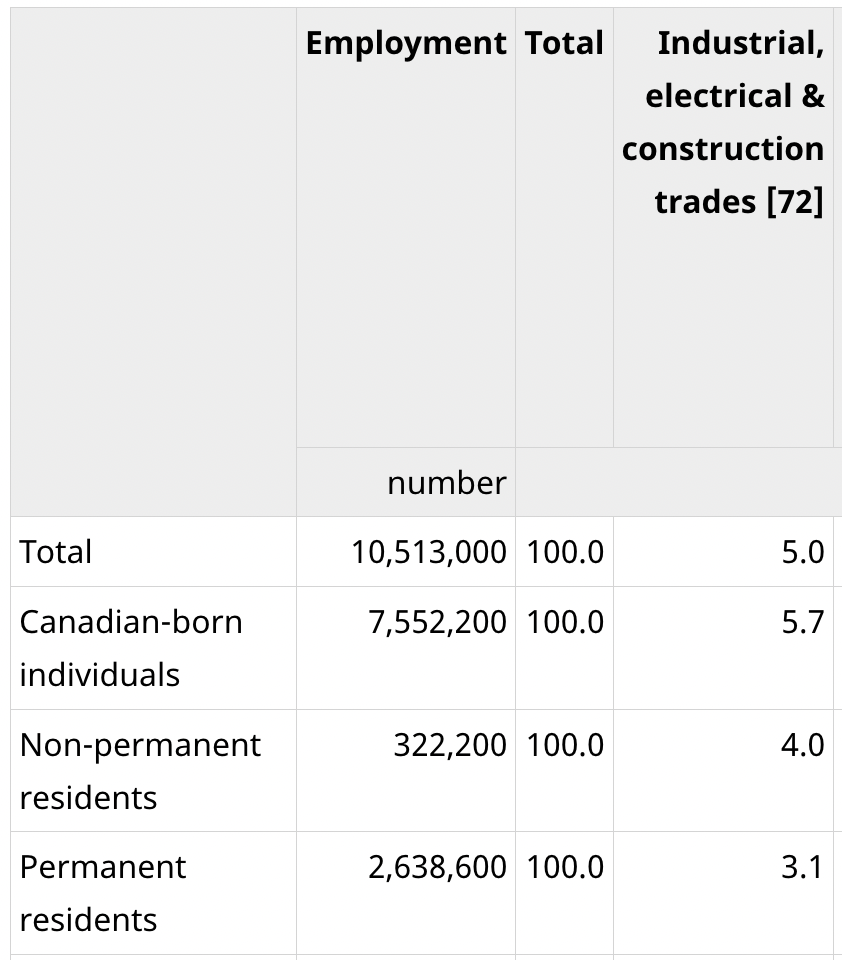
"Since 2015, less than 1 percent of permanent residents admitted to Canada have been through the Federal Skilled Trades Program"
Compare to 5.7% of Canadian-born individuals:
"However, immigrants were less likely than Canadian-born individuals to work in industrial, electrical and construction trades. About 2.5% of immigrants who landed in 2018 or 2019 worked in these occupations. They were 0.4 times as likely to work in these trades in May 2021 as their Canadian-born counterparts (Chart 1). Moreover, the relative likelihood remained the same five to six years later in March 2024, including for the more recent cohort that landed in 2021 and 2022 (Table A.2). A similar situation has existed since at least the 2010 and 2011 landing cohort, which was 0.6 times as likely as Canadian-born individuals to work in the trades in May 2021. Even among all immigrants working full time in May 2021, the relative likelihood of working in these trades was 0.5.."
That gap persists across NPRs and landed immigrants/PRs alike. Source of quote and screenshot:
I agree with your premises, but not your conclusion. Virtually none of the TFWs or recent immigration going back 16 years, be it visas, PR or citizenship have been people in the skilled trades. "Canadian-born individuals" are much more likely to be in the trades or construction than immigrants. You can see how this plays into the housing shortage and infrastructure being inadequate for a growing population, if not falling apart.see this is also a byproduct of our society fawning on white collared jobs. we simply dont have enough skilled tradesmen to do our jobs. for the last couple decades parents have been preaching to their children the stigma of not going to university and working on bay st or some other tech firm.
this is result. we dont have a skilled trades future. queue the temp foreign workers.
For immigrant labour to save Canada from the housing crisis, they'd have to be more likely to be in trades and construction than the pre-existing population, not less likely.
"Since 2015, less than 1 percent of permanent residents admitted to Canada have been through the Federal Skilled Trades Program"

Compare to 5.7% of Canadian-born individuals:
"However, immigrants were less likely than Canadian-born individuals to work in industrial, electrical and construction trades. About 2.5% of immigrants who landed in 2018 or 2019 worked in these occupations. They were 0.4 times as likely to work in these trades in May 2021 as their Canadian-born counterparts (Chart 1). Moreover, the relative likelihood remained the same five to six years later in March 2024, including for the more recent cohort that landed in 2021 and 2022 (Table A.2). A similar situation has existed since at least the 2010 and 2011 landing cohort, which was 0.6 times as likely as Canadian-born individuals to work in the trades in May 2021. Even among all immigrants working full time in May 2021, the relative likelihood of working in these trades was 0.5.."
That gap persists across NPRs and landed immigrants/PRs alike. Source of quote and screenshot:
Attachments


Last edited:

thettctransitfanatic
Senior Member

From Collapse to Dominance
[Ottawa – March 18, 2026] At the end of 2024, the Liberals trailed the Conservatives by a massive and seemingly insurmountable 25 points. Today, that deficit has flipped to a 20-point Liberal lead.…
www.ekospolitics.com
From Collapse to Dominance
How the Carney Liberals rewrote Canadian politics in less than a year
[Ottawa – March 18, 2026] At the end of 2024, the Liberals trailed the Conservatives by a massive and seemingly insurmountable 25 points. Today, that deficit has flipped to a 20-point Liberal lead.
That is not a normal swing. It may be the most dramatic one-year reversal in modern Canadian political history.
The Liberals didn’t just win what had looked like an impossible election at the beginning of 2025; they have strengthened their position since then. They are now on the verge of a “bloodless” majority, built through floor crossings and what appears to be a strong likelihood of sweeping three upcoming by-elections. Critics may object to the route, but the public does not seem to care. If an election were held today – something most voters would not welcome – the Liberals would almost certainly secure a huge majority.
The clearest casualty of this transformation is Pierre Poilievre. At the end of 2024, he looked destined for power. His coalition was energized, cohesive, and growing. He did achieve an impressive level of support, particularly in the final stages of the campaign. Another week and he might have won.
But that coalition has since fractured. The question now is not whether he came close; it’s whether he can put it back together.
The late-breaking force in the campaign was disinformation. It remains powerful, and it remains a source of potential instability. The current Liberal dominance is real, but it is not chiselled in granite. The same forces that drove this rapid realignment could destabilize it just as quickly. For now, however, the Liberals occupy the strongest position of any government in the past two decades, rivalled only by Trudeau’s one-year-out standing in 2016.
It is also worth noting that the Conservatives lead among households with three or more children. The blend of larger families, religion, and disinformation is a new force in Canada, resembling the MAHA movement in the United States.
There has also been significant churning beneath the surface. The leaderless and penniless NDP are nonetheless rising. This is not a marginal shift. The Conservatives are now closer to the NDP than they are to the Liberals. Among female voters under 35, the NDP are tied with the Liberals for first place.
The NDP’s rise is being driven by the emergence of a new progressive populist segment. These voters are skeptical of elites but strongly supportive of social programs, unions, and a more active government. They are politically homeless, but for now, they are far more comfortable with Carney than with Poilievre.
The Liberal coalition itself has also changed. Some of the “borrowed” NDP vote from the spring has drifted back, but this has been offset by gains among more moderate Conservative voters who are comfortable with Carney’s economic stewardship and tone. The result is a broader, more centrist coalition, one that now reaches into places that were previously out of bounds. Alberta is the clearest example: the Liberals are now statistically tied with the Conservatives there. That would have been unthinkable a year ago.
The salient force driving this movement is voters’ concerns with security and national sovereignty. These concerns have pushed support for higher defence spending to record levels and have elevated anxieties about disinformation, online harms, and foreign interference. The Carney government has, so far, been rewarded for its focus on national security and sovereignty.
But this is not a settled equilibrium; it is a realignment under pressure. The progressive populist segment now emerging in Canada does not fit neatly into existing party structures. Disinformation remains a volatile threat. And the underlying drivers of this shift (economic anxiety, institutional distrust, and perceived external threat) have not disappeared.
For now, the Liberals are in commanding control of the political landscape. But the speed of their rise is also a reminder of how quickly that landscape can change.
One final point. Our probability-based polling, using live-operator verification, was the first to detect the Liberal breakout last January and again among the first to identify the post-Davos Carney surge this year. In a period of rapid change, early detection matters. Following the herd is not analysis; showing important breakouts in real-time is more important.
hw621
Senior Member
I am curious what has improved since Carney became PM, affordability, housing, employment, crime rates?From Collapse to Dominance
[Ottawa – March 18, 2026] At the end of 2024, the Liberals trailed the Conservatives by a massive and seemingly insurmountable 25 points. Today, that deficit has flipped to a 20-point Liberal lead.…www.ekospolitics.com
From Collapse to Dominance
How the Carney Liberals rewrote Canadian politics in less than a year
[Ottawa – March 18, 2026] At the end of 2024, the Liberals trailed the Conservatives by a massive and seemingly insurmountable 25 points. Today, that deficit has flipped to a 20-point Liberal lead.
That is not a normal swing. It may be the most dramatic one-year reversal in modern Canadian political history.
The Liberals didn’t just win what had looked like an impossible election at the beginning of 2025; they have strengthened their position since then. They are now on the verge of a “bloodless” majority, built through floor crossings and what appears to be a strong likelihood of sweeping three upcoming by-elections. Critics may object to the route, but the public does not seem to care. If an election were held today – something most voters would not welcome – the Liberals would almost certainly secure a huge majority.
The clearest casualty of this transformation is Pierre Poilievre. At the end of 2024, he looked destined for power. His coalition was energized, cohesive, and growing. He did achieve an impressive level of support, particularly in the final stages of the campaign. Another week and he might have won.
But that coalition has since fractured. The question now is not whether he came close; it’s whether he can put it back together.
The late-breaking force in the campaign was disinformation. It remains powerful, and it remains a source of potential instability. The current Liberal dominance is real, but it is not chiselled in granite. The same forces that drove this rapid realignment could destabilize it just as quickly. For now, however, the Liberals occupy the strongest position of any government in the past two decades, rivalled only by Trudeau’s one-year-out standing in 2016.
It is also worth noting that the Conservatives lead among households with three or more children. The blend of larger families, religion, and disinformation is a new force in Canada, resembling the MAHA movement in the United States.
There has also been significant churning beneath the surface. The leaderless and penniless NDP are nonetheless rising. This is not a marginal shift. The Conservatives are now closer to the NDP than they are to the Liberals. Among female voters under 35, the NDP are tied with the Liberals for first place.
The NDP’s rise is being driven by the emergence of a new progressive populist segment. These voters are skeptical of elites but strongly supportive of social programs, unions, and a more active government. They are politically homeless, but for now, they are far more comfortable with Carney than with Poilievre.
The Liberal coalition itself has also changed. Some of the “borrowed” NDP vote from the spring has drifted back, but this has been offset by gains among more moderate Conservative voters who are comfortable with Carney’s economic stewardship and tone. The result is a broader, more centrist coalition, one that now reaches into places that were previously out of bounds. Alberta is the clearest example: the Liberals are now statistically tied with the Conservatives there. That would have been unthinkable a year ago.
The salient force driving this movement is voters’ concerns with security and national sovereignty. These concerns have pushed support for higher defence spending to record levels and have elevated anxieties about disinformation, online harms, and foreign interference. The Carney government has, so far, been rewarded for its focus on national security and sovereignty.
But this is not a settled equilibrium; it is a realignment under pressure. The progressive populist segment now emerging in Canada does not fit neatly into existing party structures. Disinformation remains a volatile threat. And the underlying drivers of this shift (economic anxiety, institutional distrust, and perceived external threat) have not disappeared.
For now, the Liberals are in commanding control of the political landscape. But the speed of their rise is also a reminder of how quickly that landscape can change.
One final point. Our probability-based polling, using live-operator verification, was the first to detect the Liberal breakout last January and again among the first to identify the post-Davos Carney surge this year. In a period of rapid change, early detection matters. Following the herd is not analysis; showing important breakouts in real-time is more important.
CMQSD402F9011
New Member
Part of it is also Provincial responsibility. Last I heard, carney or his government doesn’t fund Provincial courtrooms, Prosecutors and Jails in Ontario. That’s all on Doug Ford’s watch.I am curious what has improved since Carney became PM, affordability, housing, employment, crime rates?
hw621
Senior Member
I guess I am asking what is driving his high approval rating, if we have not seen any substantial improvement in our daily life?Part of it is also Provincial responsibility. Last I heard, carney or his government doesn’t fund Provincial courtrooms, Prosecutors and Jails in Ontario. That’s all on Doug Ford’s watch.
thettctransitfanatic
Senior Member
External factors. Trump being the biggest. The other being Pierre Poilievre being pretty unliked right now.I guess I am asking what is driving his high approval rating, if we have not seen any substantial improvement in our daily life?
Northern Light
Superstar
External factors. Trump being the biggest. The other being Pierre Poilievre being pretty unliked right now.
I think this is extremely important - the comparison factor. The relative appearance of stability and competence.
I think the speeches where he's been amplified, such as Davos, have generally created a positive 'vibe' around him.
That said, I don't think the quality of life gains are there, at this point; and I do think Canadians patience will begin to run thin if all the Globe trotting doesn't seem to yield positive traction they can feel through lower unemployment, higher wages, economic growth etc.
afransen
Senior Member
I think the issue is that PP is not a compelling alternative. He was riding high because fatigue with Trudeau was so strong. Replacing Trudeau with Carney achieved what many Canadians wanted, and many are sighing with relief that they don't need to accept PP as the alternative.I am curious what has improved since Carney became PM, affordability, housing, employment, crime rates?
hw621
Senior Member
Hope it will translate into something more positive and concrete sometime.External factors. Trump being the biggest. The other being Pierre Poilievre being pretty unliked right now.