

News   Apr 02, 2026
 2.3K     3 
News   Apr 02, 2026
 1K     0 
News   Apr 02, 2026
 2.6K     2 

GO Transit: Service thread (including extensions)

GO loses money on this operation (its subsidized); VIA was not given the $ or the mandate to offer more attractive pricing.
I'm not saying GO Transit is profitable, I'm saying it's operating costs are lower.

I don't think the comparison is particularly fair.
If the government of Ontario provided VIA with the same per passenger subsidy it will provide Mx; then the price would be lower and more attractive.
VIA is already subsidized and is controlled by the federal government. Why would the province who already owns a passenger rail carrier where it can call all the shots and make cost effective decisions, decide to subsidize the federal government's passenger rail carrier? Would this VIA service from Toronto to Niagara Falls use Bombardier/Alstom crews, double deck trains, and tight seat pitch to keep costs per passenger as low as possible? If the province wanted to run trains to Niagara with comfy seats it wouldn't need to pay VIA to do it because GO has greater efficiencies of scale than VIA. GO has more locomotives than VIA, and runs more DMUs than VIA. What expertise would the province be getting by outsourcing the Niagara run to VIA?
 
If the province wanted to run trains to Niagara with comfy seats it wouldn't need to pay VIA to do it because GO has greater efficiencies of scale than VIA. GO has more locomotives than VIA, and runs more DMUs than VIA. What expertise would the province be getting by outsourcing the Niagara run to VIA?
Along these lines, I am starting to think that between Niagara, London and the northern stuff a Metrolinx owned/operated fleet of Charger sets equivalent to the new corridor units could make a lot of sense.
 
Along these lines, I am starting to think that between Niagara, London and the northern stuff a Metrolinx owned/operated fleet of Charger sets equivalent to the new corridor units could make a lot of sense.
It could, except that GO has adopted a 610mm platform height standard for future level boarding, so it would be very inconvenient to use Siemens Venture coaches which have a 1220mm floor height. Due to their (in my opinion short-sighted) choice of 610mm, all future trains should be low-floor to avoid the need for wheelchair lifts.

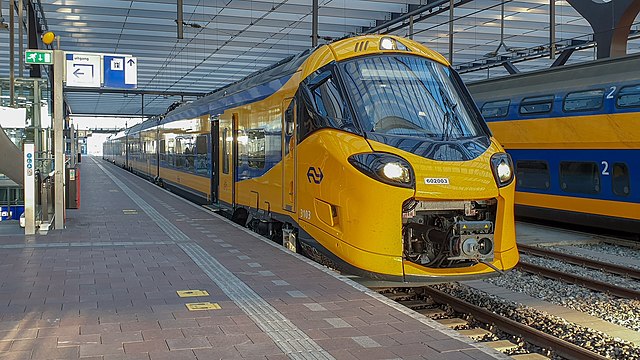
An example of a single-level low-floor intercity train is the new Alstom Corradia Stream, which is about to start service on 200 km/h services in the Netherlands:
640px-ICNG_-_Rotterdam_Centraal.jpg


There are no North-American spec single-level low-floor intercity trains because the accessible platform height standard is 48" (1220mm) for the eastern half of the continent, with the sole exception of GO Transit. Where low platforms are used, trains tend to be bilevel.
 
Last edited:
If the province wanted to run trains to Niagara with comfy seats it wouldn't need to pay VIA to do it because GO has greater efficiencies of scale than VIA. GO has more locomotives than VIA, and runs more DMUs than VIA. What expertise would the province be getting by outsourcing the Niagara run to VIA?

Like I said before, GO needs a long haul fleet if they are to expand. Nobody wants to sit on a GO transit seat for more than half an hour unless they absolutely have to.

Sitting on the GO train to Niagara is cramped and uncomfortable but it is the cheapest way out there. The problem is that more leg room, reclining seats and attendants cost money. That would add alot to both the requirements and the ticket price.

I doubt anyone would want to pay VIA rail prices for GO transit service .
 
Like I said before, GO needs a long haul fleet if they are to expand. Nobody wants to sit on a GO transit seat for more than half an hour unless they absolutely have to.

Sitting on the GO train to Niagara is cramped and uncomfortable but it is the cheapest way out there. The problem is that more leg room, reclining seats and attendants cost money. That would add alot to both the requirements and the ticket price.

I doubt anyone would want to pay VIA rail prices for GO transit service .

There's some distance between VIA's business class fare and associated standard of served and GO.
Its also a straight-forward choice to increase subsidy per rider by a reasonable sum to keep fares accessible.

Reasonable, is, of course, in eye of the beholder.

GO is currently $17.79 for Union to Niagara

VIA is not currently running in this corridor, but Brantford to Toronto is a comparable distance at $27 per seat for lowest fare.

That's not a huge gap to close.
 
Like I said before, GO needs a long haul fleet if they are to expand. Nobody wants to sit on a GO transit seat for more than half an hour unless they absolutely have to.

Sitting on the GO train to Niagara is cramped and uncomfortable but it is the cheapest way out there. The problem is that more leg room, reclining seats and attendants cost money. That would add alot to both the requirements and the ticket price.

I doubt anyone would want to pay VIA rail prices for GO transit service .

I don't think GO needs a different model of coach for longer-distance services, they just need a different interior layout. The basic characteristics of the Bombardier BiLevel are pretty much the same as the Bombardier VIRM which is the standard intercity train here in the Netherlands. The VIRM operates routes up to 300 km long (105 km longer than Toronto-London), and has a top service speed of 140 km/h (10 km/h slower than GO's current fleet).

They don't have any food service. People can pick up food before they board, and eat it onboard. Major stations have a wide assortment of retail including fast food and convenience stores, and even some smaller stations have a convenience store. Once there's regular all-day service along the Kitchener line, we could expect stations such as London, Kitchener, Guelph and Brampton to be able to support some food retail within the station, conveniently located for people transferring between trains and buses.

The main change that's actually required to support longer journeys to use airline-style row seating on the upper level. That alone increases legroom by nearly 50% by making use of the space currently being wasted behind the seatbacks with quad seating. It also allows for seatback traytables, which is super useful for supporting a laptop or tablet.

I made a quick video to show you guys around a newly-renovated VIRM unit:
 
Last edited:
Sorry, after a trip to/from London on VIA in June for the first time in decades, prefer GO seats over VIA. Hell, the GO Seats where better than the seats in a new VW Passat that I sat in for a month. Had no issues with seats to/from NF. Each to their own type of seats.

The GO train is using the KW line, lots of real slow time until the tracks are brought up to current standards.

As a note, it being cost Metrolinx $144 to subsidized riders during the COVID-19 mess and should start to fall starting in Sept.
 
Sorry, after a trip to/from London on VIA in June for the first time in decades, prefer GO seats over VIA. Hell, the GO Seats where better than the seats in a new VW Passat that I sat in for a month. Had no issues with seats to/from NF. Each to their own type of seats.

The GO train is using the KW line, lots of real slow time until the tracks are brought up to current standards.

As a note, it being cost Metrolinx $144 to subsidized riders during the COVID-19 mess and should start to fall starting in Sept.

To be fair...

I did not mind the GO train seats but having them wider with more leg room is preferable.
 
A GO service in SWO to London would be great for people in greater London, far more so than Kitchener. Unlike Kitchener where you can get downtown on a freeway from any direction, London has no urban freeways. As fellow Londoners can attest, getting to the city core is a gut wrenching experience so GO commuter trains would be much faster than driving and a hell of a lot less stressful. There are many good size commuter shed cities around London including St. Mary's/Strat/Strath/Inger/Wood to say nothing of the biggest centre of St.Thomas which could use the existing London to Port Stanley Railway.

As far as GO for getting to Toronto however, it's a no-go. It would be even slower and more unreliable than the current VIA service and that's saying something. What's more the Kitchener route is 20km longer than the Aldershot route. No one in their right mind would take GO to get to Union. Hell, even going to Pearson would be slower and vastly less reliable than the dedicated London to Pearson bus service that is already operating.
 
As far as GO for getting to Toronto however, it's a no-go. It would be even slower and more unreliable than the current VIA service and that's saying something. No one in their right mind would take GO to get to Union. Hell, even going to Pearson would be slower and vastly less reliable than the dedicated London to Pearson bus service that is already operating.
Nobody is suggesting that it's a service for people commuting to downtown Toronto. I think we also agree that it would be ridiculous to introduce without upgrading the line speeds west of Kitchener. Once that is done, the north mainline would have approximately the same travel time as the south mainline.

What's more the Kitchener route is 20km longer than the Aldershot route.

No it's not. It's 195 km via Kitchener, or 185 km via Aldershot.
 
According to my ED contacts, they've been having a lot of trouble securing materials too. Just because Metrolinx gives them a track access doesn't mean supply chain won't be an issue, especially with the Metrolinx specs.
That does not line up with what my contacts within the industry and within Metrolinx have been telling me.

Materials sourcing has been an issue with other projects, but not with this one it seems. Especially since Metrolinx has done much of the preliminary sourcing and staging of much of the materials long before the current construction firms got involved.

Dan
 
There actually is a pocket track at Burlington on the north side of the station, but it is currently disused and has been disconnected from the mainline. It was used for turnbacks back when Burlington was the western terminus of off-peak service.
View attachment 338425
Yes, part of the original mainline does still exist at Burlington Station.

And yes, there are plans afoot to connect it to the rest of the mainline tracks at the plant at Burlington East, a mile east of the station.

But none of that has been done yet, and won't be done in time for the schedule change this coming weekend.

Dan
 

Back
Top