News   Apr 27, 2026
 157     0 
News   Apr 24, 2026
 1.7K     0 
News   Apr 24, 2026
 2.4K     1 

TTC: Streetcar Network

The above discussion leads me to ask @smallspy:

1) Is it possible to refit the flexities with a suspension that would make the level boarding at modified islands work?

2) Given the problem that may cause at non-island stops, would there be any sense to segregating the fleet so that those that run on routes that are all island/platform, 509, 510, 512 had a dedicated fleet suited to that, w/the other flexities remaining configured for typical street operations.

3) Is there sufficient room at Spadina and St. Clair/St.Clair West stations to provide level boarding height platforms, given, particularly at St. Clair West, that the platform also serves buses and has to maintain its current level for stairs/escalators.
The two loops floors can be raise to match the car floor with a sloop to comply with OADA reequipments at a cost and how to do it in phases, Doing it in phases will have an impact on quality of service to the point you bus the line and do the rebuilt on a 7/24 base until it is completed. The whole area can sloop up to the area that is used for riders today than a small section for a small ramp. Doing this removes the need for the driver to leave the car to deploy the ramp. Seen systems in Europe where the driver lift the ramp out like the front door a bus when it fails faster than it does take today

If you are doing St Clair West Loop for the cars, you should do it for buses as well

As for 2), you need to do the whole fleet since they get moved around and assign to different routes all the time. Hard to have a small assign fleet for those routes for very reasons.
 

Here I think Steve makes a nuanced point, but I'm not sure I agree, as he seems to have something against walking. He would be aghast at 2 km metro stop spacing in 2nd and 3rd tier Chinese cities. 12116/6556=1.85 km for the whole country. Not apples to apples, but still...

In a hypothetical scenario where a streetcar can reach 60 km/h top speeds, you would need upwards of 400 metres between stops just to reach said speed before immediately slowing down. For 50 km/h, it's closer to 300 metres. This is why removing stops can increase average speed significantly. Obviously speed restrictions through intersections partially nullifies this, but only subtracting dwell times would underestimate the time savings.

1777179785920.png


Steve: And watch riders be extremely pissed off because they have to walk further, and the remaining stops will be more crowded and take longer to load. [...]

I don’t want transit to be less convenient for everyone because somebody is peddling the idea that stripping stops out of the system will turn streetcars into speed demons.

The average person takes 5 minutes to walk 400 metres, maybe 6-8 minutes if you're less mobile. Any greater than 400 m distance to a stop and Steve says ridership would fall off a cliff. But this is for local buses. And streetcars are not buses. And the Complete Streets Guidelines was written by know-nothings from City Transportation Services and City Planning.

It does not take long exploring research papers online to see there is a consensus that ridership tends to fall off if the walking distance to a local bus stop is over 400m, assuming level ground. [...]
If you are designing an express route, different rules apply because you are actually offering a faster trip to offset the access time penalty.
^^^Streetcars should behave closer to express buses, not slower than local buses.

Removing (many) stops isn't supposed to be easy, it's radical even for the likes of Steve Munro.
 
Last edited:
Ban on-street parking in the downtown, especially along streetcar routes. Replace with wider streetcar "express" stops (at major intersections, with transit priority signals between), but supplement with "local" bus stops where the on-street parking used to be. With matching headways or frequencies. Local residential vehicles can still use the curb lanes, deliveries allowed before 10 AM or use lane-ways or side-streets.

(Will be vetoed by "Mayor" Doug Ford, of course.)
 

Here I think Steve makes a nuanced point, but I'm not sure I agree, as he seems to have something against walking. He would be aghast at 2 km metro stop spacing in 2nd and 3rd tier Chinese cities. 12116/6556=1.85 km for the whole country. Not apples to apples, but still...

In a hypothetical scenario where a streetcar can reach 60 km/h top speeds, you would need upwards of 400 metres between stops just to reach said speed before immediately slowing down. For 50 km/h, it's closer to 300 metres. This is why removing stops can increase average speed significantly. Obviously speed restrictions through intersections partially nullifies this, but only subtracting dwell times would underestimate the time savings.

View attachment 732046


The average person takes 5 minutes to walk 400 metres, maybe 6-8 minutes if you're less mobile. Any greater than 400 m distance to a stop and Steve says ridership would fall off a cliff. But this is for local buses. And streetcars are not buses. And the Complete Streets Guidelines was written by know-nothings from City Transportation Services and City Planning.


^^^Streetcars should behave closer to express buses, not slower than local buses.

Removing (many) stops isn't supposed to be easy, it's radical even for the likes of Steve Munro.
No, you're the one who has totally missed the point that Steve has made.

It's not just about the "400m walk". Most people trying to take transit have to walk to the main street before they can walk to a stop.

Take any random stop, and draw a 400m diameter circle around it - that is, in theory, the distance that people will walk to that stop. Do the same for the next stop, and then then next again.

If you remove the middle stop of those three, you'll not only see that the area covered by the circles is far smaller, but also the distance covered away from the street that the transit is traveling on is far lower. People are not willing to walk 20 minutes just to get to a bus stop.

(Then there is the whole point that a circle is a very poor indicator of walking distance / commutershed as people can not walk diagonally across property lines in a city, but....this is easier for now.)

Your point about Chinese subways is also not relevant - subways are supposed to be further apart, because stations are expensive. There's a reason why we have tiers of service - local transit (buses, streetcars), rapid transit (subways, LRT), and commuter rail. Each has their place and their raison d'être - you don't have commuter trains stopping every 3 blocks, and you do have local transit stopping frequently enough that people are not having to walk for miles to reach their destination. And in a good system, you have integration between the different modes, so that people are able to use the appropriate mode for where they are going.

Now, you want to argue that the Toronto transit system is not integrated enough? I'm with you on that.

Dan
 
No, you're the one who has totally missed the point that Steve has made.

It's not just about the "400m walk". Most people trying to take transit have to walk to the main street before they can walk to a stop.

Take any random stop, and draw a 400m diameter circle around it - that is, in theory, the distance that people will walk to that stop. Do the same for the next stop, and then then next again.
You misunderstand. I did not miss Steve's point, I edited my wordy post earlier to get rid of "radial distance" because I know that's what people in the know would know already. I know what radial distance is. Given how math heavy my posts can be, I think you would expect me to know this concept. To add to your point, it's not really a 400 metre perfect circle, it depends on the street layout. You cannot walk to the centre of the circle from the perimeter of a 400 metre radius circle, the true distance would almost always be longer.

My point is, a 400 metre walk, the way Steve meant it, is not a long walk. But as he says, upwards of 400 metres and local bus ridership falls off a cliff. Yes, but that's for a local bus, not a streetcar. If you read his comment replies, he clearly has something against walking. A 500, 600, even 700 m walk is not a big deal.

Are Canadians inherently less capable of walking than Chinese people now?

The problem isn't proposed stop spacing being too wide as some rude replies to comments on the blog would suggest.

The problem is Canadian culture being against active transportation.

Canadians don't like walking or biking. The reason why Chinese stations are spaced so far apart, even in densely populated areas, is because originally you were expected to walk, bike, or take the bus to the station. Over time, as the networks themselves grew (and effectively densified), the average distance to the closest station shrank. The solution to better accessibility was not dense station spacing like many people on UT suggest in the relative suburbs, the solution was more lines that brought more stations. A robust, fast network beats narrow stop spacing on 1-2 subway lines. Even if it takes you 5 minutes just to walk out of the station. Some of this logic applies to streetcars as well.

----------------------------------------
My implied point on subways/metros is 1.85 km stop spacing is already much longer than the 1 km average in Toronto. We should think about why this is the case, even in high density areas near CBDs in Shenzhen, the stop spacing tends to be 1 km or longer (edit: compared to 0.3-0.6 km subway stop spacing in downtown Toronto). Cost is not the primary driver for wide stop spacing in China, it's average speeds given the litany of last mile options.

Also, Chinese metros often have long dwell times ~50 seconds due to how they operate with platform screen doors. If they had 1 km spacing, their metros would run at slower average speeds than Toronto. In reality, they tend to be faster, partly due to wider stop spacing.
------------------------------------------

Not that Steve explicitly said this, but he appears to overlook the minimum distance it takes to accelerate, then decelerate from top speed. Stop spacing under 300 metres more or less guarantees the streetcar never hits 50 km/h.

Not sure @smallspy if you are agreeing with Steve here, but clearly stop removal is a contentious topic to the point where people are downplaying the potential time savings while focusing on the one negative. My take is they should go for spacing as wide as possible, perhaps 400-500 m. I know many would disagree.

 
Last edited:
At least with the street network, we have a grid street layout. The suburban bus network used to be worse with its cul-de-sacs and crescents adding a maze to get to the bus stops, making for a longer walking distance. Some walkways and sidwalks have been added to create shortcuts through that maze, if the NIMBYs don't oppose it.
 
I'm a little confused by the argument against removing stops, if we move to Line 5 spacing, ridership will drop off? The analysis provided ignores the streetcar systems in Prague, Budapest and Amsterdam. I did a quick check on Paris and it also follows the 400-500m stop spacing. I don't think any argument for the TTCs current average stop spacing can hold water when we see these other systems.

Let's look at Spadina (maybe apples to oranges here)- if Spadina has the exact same spacing of the Yonge subway it will be a problem?

The argument for keeping Willcocks for example, creating a 679m gap (a stop I frequently use), one side if UofT and the other is low density single family homes. By far, more people suffer from the existence of this stop than benefit from it's existence. The 679m actually doesn't feel like much and a perfect example of an intersection that should close.
Removing Sussex - low density on both sides and not much through traffic. This intersection could close too creating a 597m gap. The north end is the subway. The east side is low density UofT housing. The west side has a school which takes up much land before the housing west of it.
Removing Sullivan- same distance as Yonge line. Again, unless you are able to cut through Chinatown Centre, on the west side, there isn't many to take advantage of this stop (which I use), and the east side is mostly single family homes.
Removing Nassau- Probably has the strongest argument to keep due to Kensington Market but if you are *walking* around Kensington Market, Dundas or College stops should be fine.
Removing Richmond - this should be straightforward.

Removing those stops and closing 4 of those intersections would do a great deal to speed up the Spadina streetcar.

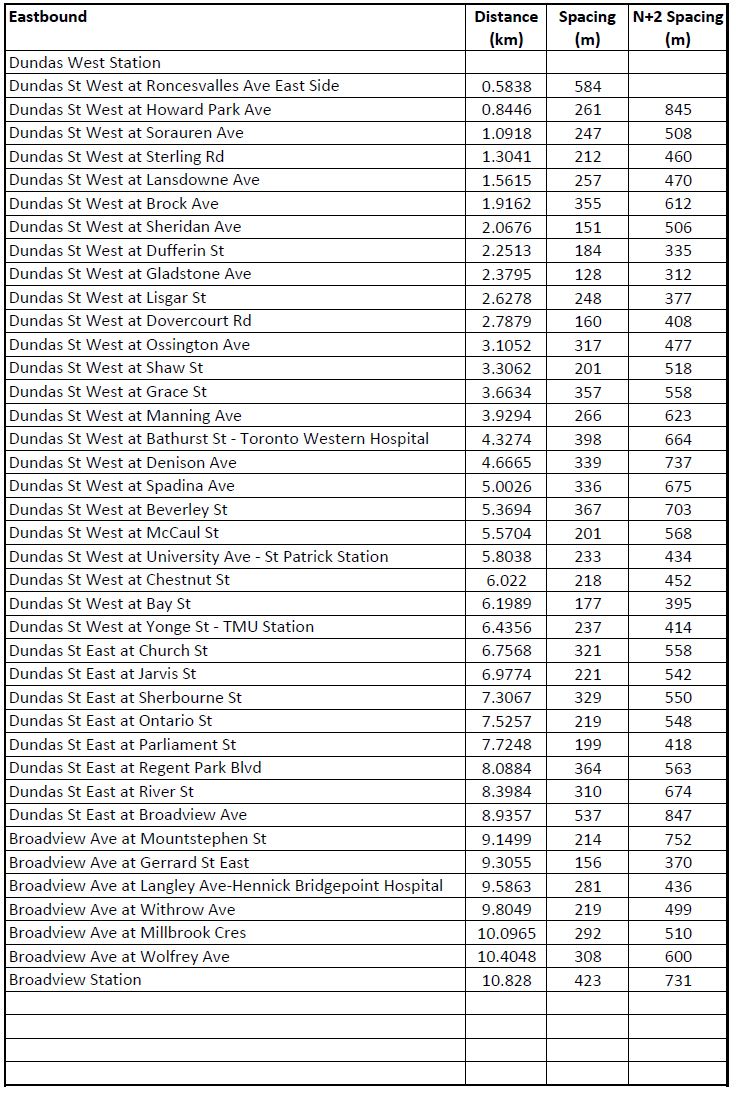
Dundas examples:
I'm not familiar with all the example Steve gave. Downtown it should go Sherbourne - Jarvis - Church - Dundas - Bay - University - McCaul (AGO+OCAD) - Huron (traffic is generally terrible here anyway - remove stop if parking was removed) -Spadina - Denison - Bathurst. I'd remove the Ontario St stops too.
  • "Chestnut: Leaves a gap of 395m EB from University to Bay, 362m WB" - that is perfectly reasonable.
Looking at Dundas, it seems only a couple stops in the core need to be removed and the spacing is good.

EDIT: I read the Dundas section of the article after posting, turns out the Huron stop has already been removed. While that's ok EB, I don't see the point WB as traffic is always snarled there and it would make no difference for most of the day.
 
Last edited:
I'm a little confused by the argument against removing stops, if we move to Line 5 spacing, ridership will drop off? The analysis provided ignores the streetcar systems in Prague, Budapest and Amsterdam. I did a quick check on Paris and it also follows the 400-500m stop spacing. I don't think any argument for the TTCs current average stop spacing can hold water when we see these other systems.

I agree with @TRONto reiterating the comparisons. And I'll give it to stop savers like Steve, that it's not black and white, and removing stops wouldn't be a panacea. However, too many people are letting their own personal biases cloud their judgement. Some people struggle with walking, yes. But most people are physically capable of walking for 10 minutes. And more people would be willing to walk 10 minutes in the first place if the streetcars were faster. Trams should not be slower than downtown buses. To quote Steve: "you are actually offering a faster trip to offset the access time penalty."

It boils down to if you believe streetcars should be rapid-y transit. If you're content with streetcars being as slow/as fast as local buses, then by all means, keep the stop spacing, focus on the other 4 ways to speed them up. The streetcars are currently slower than local buses and bus replacements. Rapid transit cannot be very local and rapid at the same time.

1777221357896.png


1777222079171.png
 
Last edited:
I agree with @TRONto reiterating the comparisons. And I'll give it to stop savers like Steve, that it's not black and white, and removing stops wouldn't be a panacea. However, too many people are letting their own personal biases cloud their judgement. Some people struggle with walking, yes. But most people are physically capable of walking for 10 minutes. And more people would be willing to walk 10 minutes in the first place if the streetcars were faster. Trams should not be slower than downtown buses. To quote Steve: "you are actually offering a faster trip to offset the access time penalty."

It boils down to if you believe streetcars should be rapid-y transit. If you're content with streetcars being as slow/as fast as local buses, then by all means, keep the stop spacing, focus on the other 4 ways to speed them up. The streetcars are currently slower than local buses and bus replacements. Rapid transit cannot be very local and rapid at the same time.

View attachment 732091

View attachment 732103

I greatly respect Mr. Munro and the work he does but as of late I can't help but find him... a bit offputting to everyone who deviates about a tenth in any direction from his position. Perhaps I just haven't paid any attention to his comments on other posts or he just REALLY cares about this particular subject, but he's very rude with the "Listen you turd," and "Maybe you would be a tad less pompous without hiding behind a pseudonym" comments to anyone who has a deviation from his post. He also got into spats online with other transit advocacy groups who deviated from how he thinks the system should be improved slightly.

Personally, While I do believe some stop culling is in order, I don't believe we will see many benefits until many of the other procedures to speed up the streetcars are in order-- not an argument that it shouldn't be done, however, as it kind of all relies on each other. I just don't really see a reality where LRTs will 'replace' the job of subways for cheaper without accepting the very tradeoffs that made subways desirable, namely the speed, which was set by the spacing... One of the poor problems with the FWLRT was primarily that end-to-end speeds mattered much because there was only the Finch West connection, and the other end was Humber College. As Urban said, either you have to accept that trams/LRTs will not be the rapid-transit subway-replacing machines Transit City promised and stop acting like they are, or treat them with the same amount of care for speed that we give subways. Can't have your cake and eat it too. And I think that's fine to an extent, I think trams should serve the middle ground between buses and subways-- but they can't be just buses on rails.
 
I think trams should serve the middle ground between buses and subways

^This exactly, assuming you mean middle ground speed. I find it unacceptable that the streetcars can be often slower than their bus replacements. I think the argument from Steve and others is that improving TSP, slow operations, etc. would be enough to make streetcars faster than buses, thereby removing the need for extensive stop removals. On that, I have my doubts.

I'll also add, the TTC streetcar network is already very dense. 83 km of streetcar in a much smaller area vs. 70 km of subway. From Bloor to Front is less than 3 km North-South. It would not surprise me if 1 million people live within 500 metres of a subway or streetcar stop (and most still would if almost 50% of the streetcar stops were removed).

Chengdu, China for reference: "As of 2021, about 2.2 million and 4.6 million people live within 500 and 800 metres (1,640 and 2,625 ft) of a subway station in Chengdu, respectively." (Wikipedia) Counting interchange stations once, Chengdu Metro averages ~1.99 km stop spacing as of 2025.

If you remove the middle stop of those three, you'll not only see that the area covered by the circles is far smaller, but also the distance covered away from the street that the transit is traveling on is far lower. People are not willing to walk 20 minutes just to get to a bus stop.
King to Queen (~350 m), Queen to Dundas (~450 m), Dundas to College (~600 m), Bathurst to Spadina (~600 m) are so close together, their 400 metre circles are all overlapping. Even if we go off what Steve is saying, we could easily have stops be spaced 400+ metres apart and still have overlapping circles covering most of Downtown. (See charts below).

The adjacent streetcar lines (and their streets) would have to be much farther apart before the walk is consistently more than 400 metres long. And again, a 400 metre walk is ~5 minutes for most people. I would argue a 10 minute walk is the hard limit for rapid transit.

https://www.medicalnewstoday.com/articles/average-walking-speed#average-speed-by-age

The problem is Canadian culture being against active transportation.

Canadians don't like walking or biking. The reason why Chinese stations are spaced so far apart [2 km], even in densely populated areas, is because originally you were expected to walk, bike, or take the bus to the station. Over time, as the networks themselves grew (and effectively densified), the average distance to the closest station shrank. [See Chengdu]
1777229343782.png


For the area between two streetcar lines, assuming regular/unstaggered stop spacing, and uniform population distribution (in reality, people are more likely to live on larger streets, which would lower walking distances):
1777236874942.png

1777236235925.png
 

Attachments

  • 1777229187316.png
    1777229187316.png
    1,003.1 KB · Views: 1
  • 1777235981251.png
    1777235981251.png
    146.1 KB · Views: 0
  • 1777236247931.png
    1777236247931.png
    145.1 KB · Views: 2
Last edited:
Do people complain that the 400-600 meters between subway stations in downtown is too long for old/disabled people? On those routes, we have chosen speed over spacing distance. So why is it controversial to give streetcars "LRT" distances? The towers full of people in downtown also contain the old and disabled. I do not see any effort from that crowd to add a supplementary bus on the Bloor-Danforth line to help with the walk.

Just a random example: the distance between Dufferin and Ossington stations is over 700m. I assume many streetcar stops were removed between them when the subway opened. Is that area seen as bad for the people with limited mobility who live there? Should we add a supplementary bus service there? Why is no one talking about this if such a distance is too large?

Now, if a streetcar has a stop every 500m, is that so bad?

This, to me, comes across as a bias towards what is already there.

And I am generally a fan of sub-1 km spacings for subways. I find walking tedious. But I want to actually find the streetcars useful. Right now, I avoid them as taking basically any mode of movement is faster than them, including mobility scooters. (ok this last one is hyperbole. Scooters are slightly slower than streetcars at 11km/h)
 
Now, if a streetcar has a stop every 500m, is that so bad?
The crazy thing is 500m likely won't happen in this wave of streetcar improvements (done by 2028?). The range they said they were going for was 300-400m. So me saying 400m is already on the high end.

The charts show, if stop spacing is an even 400 m, for most of Old Toronto south of Bloor, it's a ≤400 m walk for upwards of 75% of people (800 m route spacing, 400 m stop spacing). For most of Downtown south of Bloor, it's a ≤400 m walk for upwards of 91.7% of people (600 m route spacing, 400 m stop spacing).

This, to me, comes across as a bias towards what is already there.
As much as UT'ers trend toward pro-transit-progressive, I also notice a lot of bias towards what is already there, i.e. system justification bias.

Here is what 600 m route spacing and 500 m stop spacing looks like (between Dundas & College at the widest points, and Bathurst & Spadina).

Median 275 metres is 3'48" at 4.34 km/h, or 4'49" at 3.42 km/h.
Call it 4+ and 5+ minutes to account for red lights and stop signs.

98.3 percentile 500 metres is 6'55" at 4.34 km/h, or 8'46" at 3.42 km/h.
Call it ~8 and ~10 minutes to account for red lights and stop signs.

Is it that big of a deal that roughly 1/6th of people have to walk more than 5-ish minutes (400 metres @ 40 year old/median age speed) to the streetcar stop? Virtually everyone at every age is within 10 minutes of a stop (500 metres).

1777263602053.png


1777264336713.png


350 m stop spacing is more realistic for this wave of improvements:

94.6 percentile 400 metres is 5'32" at 4.34 km/h, or 7'01" at 3.42 km/h
1777264779427.png


20-30 minutes of aerobics is recommended for seniors. Worst worst case, is walking 20 to 40 minutes for a round trip that big of a deal? 10 minutes from home to the initial stop, another 10 minutes after arriving at the destination stop to get to your destination, 10 minutes back to the destination stop, 10 minutes from the initial stop to home. Use it or lose it.
 

Attachments

  • 1777264026163.png
    1777264026163.png
    26.6 KB · Views: 0
I wonder if some streetcar stops being removed would also allow for the removal of traffic signals at the same intersections. One example that sticks out to me is Dundas Street West at Sheridan Avenue - it's less than 200m from another streetcar stop in each direction (Brock Ave to the west and Dufferin Street to the east) and, when including Gladstone Avenue east of Dufferin, creates a sequence of four consecutive traffic lights in half a kilometre. Might that also be contributing to the sluggish speed of the streetcars?
 

Back
Top