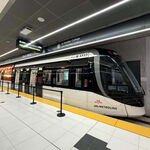
At risk of belabouring this point, I took the line today and was not impressed with its speed (or rather, its lack thereof). I recorded my trips using a GPS app and it told me that my average speed from Finch West to Humber was 10.8 km/h (57 min), and my average speed on the return leg was 12.6 km/h (48 min). Do keep in mind that this is a slight overestimate, as there was no GPS signal for the first 1-2 minutes the LRV spent ambling along underground at ~10 km/h, and the true average speed would be even lower.
The nice thing about this app is that it provides a very detailed trip summary, including a GPS trace and a speed/time graph. It's the graphs in particular that I want to share, in part to bring some data back to this discussion which seems to have wandered back into the tired debate of LRT/subway/second class citizens/etc.
First, the summary pages:
And now the graphs, enlarged and annotated by me:
The blue line represents speed. The orange line represents altitude, which for our purposes can be ignored (it's not very accurate, anyways).
I've used yellow "H"s to represent time spent at stops, and red "H"s to represent time spent waiting at red lights. I've also circled each time the LRV stopped at a red light before proceeding to a far-side stop.
The first thing that sticks out is the cruising speed of just 30-40 km/h. The line has a speed limit of 60 km/h, and it makes no sense to run the trains slower than they need to be. The line is literally built for 60 km/h operations--this is perhaps the lowest hanging fruit in terms of ways to speed up the line.
I've also heard that there is a 25 km/h speed limit through intersections. While I hoped for these graphs to show if this was the case, I don't have any definitive evidence of this, at least on the trips I took. However, there is some circumstantial evidence in that the only section where the LRV seemed to move with any sense of urgency is between Kipling and Islington, a dead-straight section of track where there are no intersections. There's also a moment in the return trip where the speed seems to drop when passing through an intersection, but I only caught that one instance. Of course, it's also possible that driving at a top speed of ~30 km/h makes the deceleration less noticeable. Eliminating this rule (assuming it exists) would be another way to speed up journeys without making any changes to the physical infrastructure.
Now we come to the issue of traffic lights. I will echo the calls for transit priority, because my god these things stop way too much. On the first leg, there were 10 instances of double-stopping, representing over half of the 18 stops!! It is absurd to think that we spent 2.5 billion dollars on this only for it to have the same problem as the streetcars.
All of this is to say that the line has no reason to be this slow. While it will never be subway speeds, it can (and should) definitely travel faster than 13 km/h!