

Midtown Urbanist
Superstar
The latter. Our traffic lights have been programed to be allowed to do this for like two decades or more? We just choose to not.Do we really need funding to fix this? Or can we just flip a switch and turn it on?
|
|
|
The latter. Our traffic lights have been programed to be allowed to do this for like two decades or more? We just choose to not.Do we really need funding to fix this? Or can we just flip a switch and turn it on?
I've been sifting through a lot of comments here centred on the LRT vs subway vs streetcar vs bus debate - which I'm pretty sure we've been having on this forum for close to 20 years, but I'm genuinely interested in where the holdup with turning on signal priority lies? Who's to blame here and who can actually get it running now that the line is operating?Do you have a source for this? That we should be attributing the lack of strong signal priority to the city council and mayor? (instead of Metrolinx and TTC)
The contracts were signed and sealed under Wynne.Do you have any source for Ford wanting this to become an elevated rapid transit line? Cuz this sounds entirely made up. Construction of this line started under Ford’s government.

Do we really need funding to fix this? Or can we just flip a switch and turn it on?

Council decided not to enable full signal priority years ago. Last year a motion was brought to council to look at enabling it again and they were supposed to get a report beck a few months ago but it's been radio silence. City council also has the power to enable better transit signal priority on several bus corridors and on eglinton.I've been sifting through a lot of comments here centred on the LRT vs subway vs streetcar vs bus debate - which I'm pretty sure we've been having on this forum for close to 20 years, but I'm genuinely interested in where the holdup with turning on signal priority lies? Who's to blame here and who can actually get it running now that the line is operating?
Need funding to pay the (union) staff to flip an extra switch, and drive more attentively (due to the faster speed) lolDo we really need funding to fix this? Or can we just flip a switch and turn it on?
City Traffic Services.I've been sifting through a lot of comments here centred on the LRT vs subway vs streetcar vs bus debate - which I'm pretty sure we've been having on this forum for close to 20 years, but I'm genuinely interested in where the holdup with turning on signal priority lies? Who's to blame here and who can actually get it running now that the line is operating?

TSP on Line 5 Eglinton and Line 6 Finch West
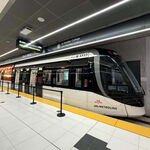
Line 5 Eglinton and Line 6 Finch are being delivered by Metrolinx, and as specified in the project agreements between Metrolinx and its constructors, TSP has been installed at all intersections on the at-grade sections of Line 5 and Line 6. Specifically, TSP is installed on the Line 5 surface segment on Eglinton Avenue from east of Laird Station to Kennedy Station; and on Line 6, TSP is installed on the surface segment between Humber College and Finch West Station.
The LRT lines implement Conditional TSP whereby priority is only given when vehicles are behind schedule to help schedule adherence and maintain service reliability. The amount of extension provided varies by time of day based on the available time that can be taken from other movements. Conditional TSP on the LRT lines achieves the following:
• helps maintain schedule adherence LRT operations and helps minimize bunching on the transit lines;
• maintains safety for pedestrians, ensuring that there is sufficient opportunity to allow pedestrians to safely cross the street and board transit; and,
• balances coordination between both east-west and north south transit transfers which will allow customers to safely transfer between bus routes and the LRTs.
The responsibility of TSP design and commissioning currently rests with Metrolinx until Line 5 and 6 are completed. Once the two lines are complete, and hand-over of the new lines has occurred, the City of Toronto Transportation Services and the TTC will continue to refine TSP strategies through the Train Operating Funding Agreement and Train Operating Services Agreement, including looking at any appropriate opportunity for unconditional TSP, to provide customers with fast and reliable service on the new LRT lines.


It would be an interesting loophole to just increase the scheduled times for the train so that TSP is always on.This is from the Supplementary Report: Congestion Management Plan - 2025 Update dated April, 2025.
So TSP will only happen should a light rail train be behind schedule. In other words, the trains are slow because they are ON SCHEDULE.
Am I reading that right?
How about you just tell us two falsehoods?Sorry, but... Are we supposed to count how many atatements in that video are factually incorrect?
This seems perfectly reasonable if the trains on the surface were running at a consistent speed, but they won't be. Sometimes they'll be stopped at a redlight for several minutes. Does that means all trains in the tunnel will just extend their dwell times to compensate?

Technically the city and province are the same entity - yet they sue each other. And look at how much Toronto Hydro screws over City of Toronto construction projects - despite being 100% owned by the City.Technically they are the same entity
After years of operating them already? If they weren't ready, it shouldn't have opened. The bad press from this (which I don't think has barely scratched the surface yet), could be epic.The reality is, the TTC operators still need to familiarize themselves with these new trains before they can feel comfortable operating them at 60 km/h without incident.

There's no doubt that the underground trains will be slowed down by at-grade trains. Otherwise we'll see bunching up of eastbound trains around the tunnel portal.