News   Jan 22, 2026
 154     0 
News   Jan 22, 2026
 195     3 
News   Jan 21, 2026
 531     0 

The Future of subway and rapid transit in the GTA

Au contraire, my view is that a better TSP and other improvements to the LRT operation should be attempted first. Finch West LRT is a perfect use case, anything that works there should work in other suburban LRT corridors.

However, it is hard to plan or fund any new suburban LRTs until and unless it is demonstrated that Finch West LRT works well after all the changes.
 
Somehow the conclusion of many users in this thread is "we must never build LRT in Toronto again because it's impossible to have a good LRT in Toronto" and not "we need to make simple, obvious changes to our existing and future LRTs so that LRTs can work in Toronto, like they do everywhere else".

Thankfully our mayor and council are pushing for those needed changes.
Toronto is a Victorian city, with a 20 m wide streets, surrounded by a suburban post war hell scape (East York, North York, Etobicoke, Scarborough, York, Richmond Hill, Mississauga, Brampton, Mississauga, Vaughan, Markham.) That street grid layout (narrow streets in the core, much wide outside the core) creates a natural bottle neck the closer you get to downtown.

Those simple and obvious changes haven't happened in 150 years. Those city councillors, that for some strange reason you praise, have never done anything to help anyone riding public transit on a regular basis. Ever.

Here's the reality. Old Toronto is a densely populated urban city dominated by an overpowering suburban agenda. If amalgamation had never happened, we'd still be overruled by the Province of Ontario at every turn.

I think unreasonable to be optimistic given the history of how things have developed here.
 
Au contraire, my view is that a better TSP and other improvements to the LRT operation should be attempted first. Finch West LRT is a perfect use case, anything that works there should work in other suburban LRT corridors.

However, it is hard to plan or fund any new suburban LRTs until and unless it is demonstrated that Finch West LRT works well after all the changes.
As I stated in an earlier post in the Finch West, Line 6 thread, the lack of "two stage pedestrian crossings" is going to make it difficult for the city to implement any strong TSP for the line.

 
As I stated in an earlier post in the Finch West, Line 6 thread, the lack of "two stage pedestrian crossings" is going to make it difficult for the city to implement any strong TSP for the line.

It's been stated several times in response to your claims that it's not an issue.
 
It's been stated several times in response to your claims that it's not an issue.
Considering that streetcars and LRTs fall under the "Vision Zero" plan, it'll be an issue. The city won't put aggressive TSP at intersections if they think it puts pedestrians at risk. TTC will no doubt deem it unsafe.
 
Considering that streetcars and LRTs fall under the "Vision Zero" plan, it'll be an issue. The city won't put aggressive TSP at intersections if they think it puts pedestrians at risk. TTC will no doubt deem it unsafe.
They just have to trigger a TSP signal from far enough away for the cross street to have enough green time for the pedestrians to cross, it's not hard to grasp.
 
Considering that streetcars and LRTs fall under the "Vision Zero" plan, it'll be an issue. The city won't put aggressive TSP at intersections if they think it puts pedestrians at risk. TTC will no doubt deem it unsafe.
If you read through above, it's clear that this is a non-issue. Why do you keep repeating the same things ad-infinitum?
 
Toronto is a Victorian city, with a 20 m wide streets, surrounded by a suburban post war hell scape (East York, North York, Etobicoke, Scarborough, York, Richmond Hill, Mississauga, Brampton, Mississauga, Vaughan, Markham.) That street grid layout (narrow streets in the core, much wide outside the core) creates a natural bottle neck the closer you get to downtown.

Those simple and obvious changes haven't happened in 150 years. Those city councillors, that for some strange reason you praise, have never done anything to help anyone riding public transit on a regular basis. Ever.

Here's the reality. Old Toronto is a densely populated urban city dominated by an overpowering suburban agenda. If amalgamation had never happened, we'd still be overruled by the Province of Ontario at every turn.

I think unreasonable to be optimistic given the history of how things have developed here.


Your description of Toronto's build form is true. The suburbs are big and spread out. They have lower transit ridership potential than higher density areas, so LRTs (lower capacity, higher coverage) make more sense there than heavy rail (higher capacity, lower coverage).

Toronto's political landscape 150 years ago, or even 5 years ago, is irrelevant. The government of the 1920s removed the St. Clair streetcar right of way. The government of the 2000s put it back. Attitudes towards these things can change over time.

As for signal priority: there wasn't the political will to implement those changes. There is now. So things have been poorly done for 150 years, therefore they must be poorly done forever?

Additionally, there has been essentially no opposition to these changes. The vote passed city council almost unanimously and the province hasn't moved to block anything.
 
Last edited:
Your description of Toronto's build form is true. The suburbs are big and spread out. They have lower transit ridership potential than higher density areas, so LRTs (lower capacity, higher coverage) make more sense there than heavy rail (higher capacity, lower coverage).

Toronto's political landscape 150 years ago, or even 5 years ago, is irrelevant. The government of the 1920s removed the St. Clair streetcar right of way. The government of the 2000s put it back. Attitudes towards these things can change over time.

As for signal priority: there wasn't the political will to implement those changes. There is now. So things have been poorly done for 150 years, therefore they must be poorly done forever?

Additionally, there has been essentially no opposition to these changes. The vote passed city council almost unanimously and the province hasn't moved to block anything.

Voting on or in favour of TSP in not really encouraging to me, nor is it a sign that there's a shift in suburban mentality or a shift in city councils approach to prioritizing transit.

I don't think you can change the ethos without changing the built form of those suburban streets ultimately.
 
As I stated in an earlier post in the Finch West, Line 6 thread, the lack of "two stage pedestrian crossings" is going to make it difficult for the city to implement any strong TSP for the line.


There are several potential strategies for reducing the LRT's wait times. If some of them (shortening the cross-street green phase) can't work, others are still available.

You can extend either phase, to increase the chance that the LRV can cross when it is ready to cross; of course that requires good calculations / predictions. And / or, you can do a short phase insertion, so that the LRV can cross before the left-turn phase begins.

That's the whole point of having a running use-case. All theories can be put to a practical test.

I think, what they can achieve with a better TSP by the beginning of this summer, is the best they will ever achieve with TSP alone. If the outcome is still not good enough, then some more controversial changes will have to be considered. Either changing the speed rules, eliminating those restrictions that do not really contribute much to safety. Or, seriously cutting the number of stops (and running parallel bus service, something the TTC definitely wishes to avoid on Finch West).
 
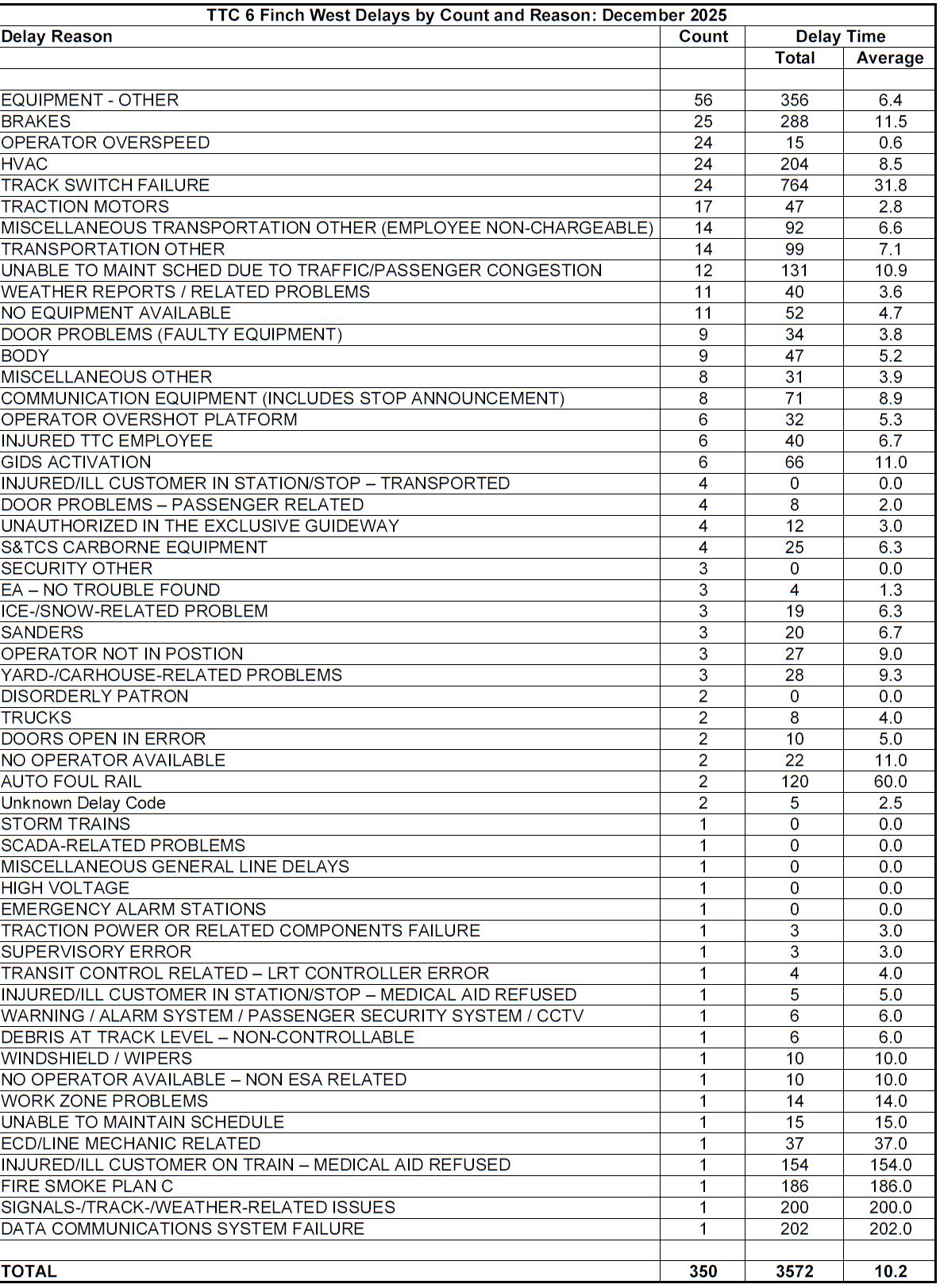
Steve Munro has a piece up looking at all delays on this line from Dec 7th through Dec 31st.


Some of the numbers are alarming in terms of frequency:

View attachment 710318

So three weeks into the line, we had 24 different instances of delay caused by switch failures! Holy @#$#

24 with HVAC, which I hope, at this time of year, means heating. In general the failure, I'm assuming, is either lack of heat, or the system overheating, neither is acceptable at this stage..........but 24 times in 3 weeks? That's more than 1 instance per day!

17 incidents with traction motors.......

6 for 'No equipment available??

Most of the 1s and 2s are things you can imagine coming up; even some of the 3s and 4s along with 'ill passengers' or the like.

But the number of mechanical faults either in the vehicles or the switches is really extraordinary to me.

Lots of issues w/brakes as well. Something I have heard is a possible issue coming up for Line 5 as well.

Besides the 'will it fit' issue with potential future LRTs in Toronto... The bar is so low for Metrolinx and Canadian industry that we simply cannot expect high quality, reliable vehicles and equipment for any transit type. Be it low or high floor, tram or metro.

Although this isn't the deal-breaker for low floor trams, it contrasts with how it is more difficult to screw up a high floor system. High floor vehicles tend to be more reliable because they are mechanically simpler and easier to maintain.

Needless to say, full grade separation, where tracks aren't run over by cars on a daily basis is more reliable than at-grade operation.

It's just easier to get a high floor tram or metro right. Even if they unsurprisingly screw up the quality management for vehicles and wayside infrastructure, high floor lines are likely to be more reliable.

This should be considered when planning the next round of transit expansion in Toronto.
 
Came back from London a couple days ago, and it really hammered home to me how we're just doing everything wrong not just in Toronto, but within Ontario in regards to transit (Ottawa, Hurontario LRT, etc.).

The Jubilee line was probably the fastest subway I ever rode! It absolutely takes off! The Elizabeth line continues to be a gem and has proven itself to be a complete game changer for London.

I highly recommend that Canadian transit advocates go to another city, like London, and get perspective on a city that does transit right!

I will admit though that the only downside to London transit is that it's somewhat expensive. I wasn't paying too much attention to the numbers, as I was just tapping my WISE card at every station.

London truly is a city where you don't need to drive. Even the buses are decent. I rode on the Bakerloop.

How exactly do our politicians realistically expect Canadians to choose transit over driving when they continue to build garbage like Line 6 in Toronto?

I didn't capture too many photos or videos of my transit journeys in London as I was too busy enjoying myself, and I didn't want to look like a typical tourist, filming people at the stations.

I attached my results from riding the TfL Tram from East Croydon to Wimbledon. I should preface the tram, outside of Croydon, isn't entirely street running and appears to mostly run on an abandoned rail track. One of the things that impressed me the most was that at one stop a fare inspection was performed, and the whole process only took roughly 2-3 minutes. As we pulled into the stop, the fare inspectors had lined themselves up along the entire platform with their scanners ready, and they all boarded as soon as the tram came to a stop. After they checked all the riders, their supervisor thanked us for our patience, they all quickly disembarked, and we proceeded on.

20260114_080552.jpg

20260117_144720.jpg
Screenshot_20260115_075224_Speedometer.jpg
 
Last edited:

Back
Top