Toronto 405 Sherbourne | 120.1m | 35s | TCHC | Alison Brooks

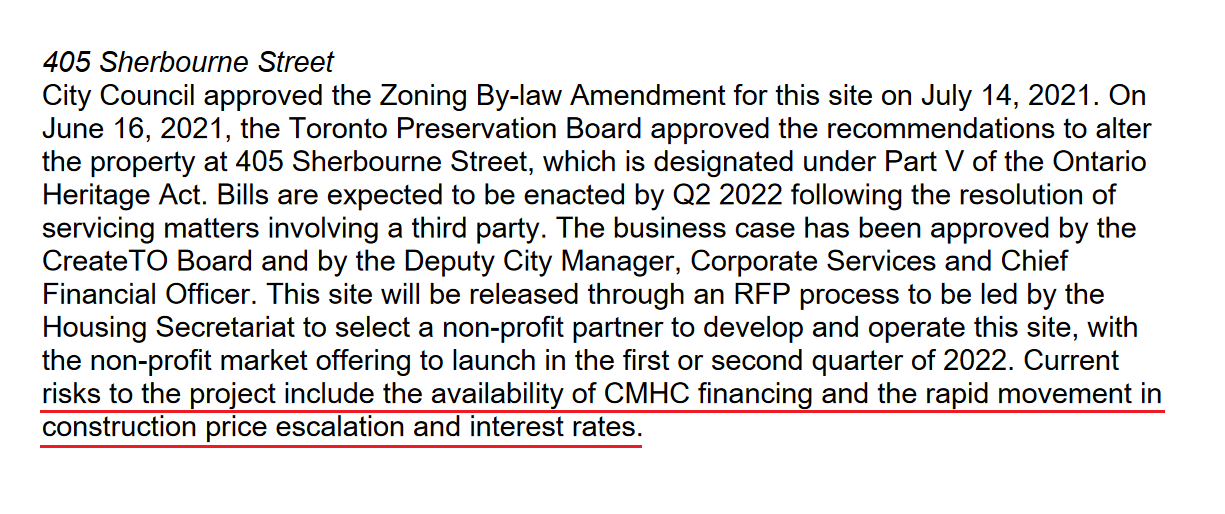
At CreateTO Board meeting today - the said that they are expecting a not-for-profit RFP to go out to market in Q2 2022 - they also highlighted the key RISK(s) on this site...

PDF - https://www.toronto.ca/legdocs/mmis/2022/ra/bgrd/backgroundfile-222172.pdf
1646683553098.png


405 Sherbourne St.:

Currently a Green P parking lot, 405 Sherbourne St. is part of Phase Two of the City's Housing Now Initiative. Housing Now is a City-wide initiative with 17 locations across Toronto where new mixed-income, mixed-use development will be built to support complete communities. In July of 2021, City Council approved the zoning by-law for this site, which will facilitate the revitalization of a 26-storey mixed-use building with 267 rental units, of which a minimum of 33% will be provided as new affordable rental. In addition to the minimum 33% affordable units, staff will look for opportunities to create 40 units of supportive housing onsite as part of the overall 267 rental units. The development concept also includes at least 168 square metres of community space, and a new landscaped mid-block connection. The City is expected to issue an RFP for a non-profit housing provider to develop this site by the third quarter of 2022.
 
The 2024 budget submission by the Toronto Parking Authority (headed in report form to next week's meeting) seems to suggest construction will begin here in 2024:


Second last page.
The 405 SHERBOURNE site has not gone out to RFP yet, but we did suggest to Mayor Chow's team that this site was on the list of "City Owned & Already Re-zoned" if she wanted locations to PILOT her new Public Builder proposal...

 
...redevelopment within the "Heritage Conservation District" passed at this morning's Board meeting, next stop is probably Planning & Housing Committee on June 28th...

Sorry to bump a post in a thread from years ago, but these outrageous 'heritage districts' and 'no new net shade' policies seem so ripe for some major discrimination lawsuit I am shocked one has not yet been brought to the courts yet. I am far from a lawyer, but quite fine grain racial and income data exists for these neighbourhoods that have seen layers upon layers of additional legal protections and avenues of dispute handed over to statistically much whiter and wealthier areas (or even streets). Built form is a very shaky excuse, especially considering the inclusion of parking lots, like 405 Sherbourne itself and various SFH remodels/full rebuilds. Could the carving out of statistically lower income/more diverse clusters as seen with this map not constitute a systemic denial of certain groups to municipal services at the cost of property values/quality of life?
1704321338529.png
 
Sorry to bump a post in a thread from years ago, but these outrageous 'heritage districts' and 'no new net shade' policies seem so ripe for some major discrimination lawsuit I am shocked one has not yet been brought to the courts yet.

I don't see why.

I am far from a lawyer, but quite fine grain racial and income data exists for these neighbourhoods that have seen layers upon layers of additional legal protections and avenues of dispute handed over to statistically much whiter and wealthier areas (or even streets).

This is not generally true.

First off many 'neighbourhood' zoned areas are very diverse and indeed majority minority. Second, apartment neighbourhoods also have protections. The idea that these are afforded by race is not evidence based, and is the sort of statement likely to get vitriolic backlash.

Built form is a very shaky excuse, especially considering the inclusion of parking lots, like 405 Sherbourne itself and various SFH remodels/full rebuilds. Could the carving out of statistically lower income/more diverse clusters as seen with this map not constitute a systemic denial of certain groups to municipal services at the cost of property values/quality of life?

No.

What services do you imagine are being denied? Toronto in fact allocates lots of extra resources to areas with economic challenges; from Free Recreation Centres to expanded libraries to publicly funded, free dental care.


The carve out in the area above is specifically because the buildings included are not heritage buildings. How would justify imposing heritage-related protections for buildings that much newer and not in character w/the generally Victoria buildings which are protected?

The point of the Heritage Conservation District Status is to protect buildings that look like this:

1704322488869.png


This is what is excluded:

1704322566262.png


It clearly is not consistent w/the architectural character of those other buildings, on what basis would you assign it the same status?

To be clear, the different statuses in that map do not connote differences in library, recreation, parks, garbage, policing or other services.

All they do is say, is that if you could otherwise gain permission to demolish any of those homes so listed that you must rebuild in keeping w/the architectural scale/colour palette etc of the street. That's it.
 
In terms of services, I was referring to the additional bureaucracy that developments within these designated zones must go through, as I believe @HousingNowTO made some light of the parking lot going through a heritage review further up the thread. I should have clarified, these heritage areas are not getting their bushes pruned by the city per say, but the amount of time city staff spend on appeasing the 'neighbourhoods' and especially those deemed heritage seems to far outstrip the 'apartment' neighbourhoods/sites of the city. I have not culminated any hard statistics on the matter, but I am sure we are familiar with the differing levels of pushback a project close to say Royal York Station would receive compared to the pushback a project at the adjacent Islington Station would experience.

And yes the neighbourhoods, especially in the boroughs are incredibly diverse, as this map displays. However the closer to the core a neighbourhood is, the more expensive and limited the 'neighbourhoods' are. Cabbagetown is infamous for its exclusivity and high level of white residents, a fact which this map represents very clearly. (Based on 2011 Stats Canada Census).

You've conflated two different issues; neither of which bear on the appropriateness of heritage rules and misrepresented the labour allocation in respect of the latter.

*****

1) Yes, neighbourhoods are unequal by income, that is not the same as discriminatory by skin colour or ethnicity.

2) Yes, some people of some backgrounds are disproportionately better off. That is generally not a function of racial/ethnic discrimination in the current period, and indeed conflating it as such will likely sustain and increase the disparity.

The discrimination, per se, is against low-income earners of all backgrounds.

The problems are equal access to higher education, equal access to healthcare, equal access to high employment standards and income etc. Heritage laws don't prevent someone from going to medical school or becoming an engineer. Heritage laws
don't provide inadequate social supports to the neediest, nor do they offset the disadvantages for those that lack inherited wealth.

Conflating something better addressed by higher minimum wage, lower university tuition, and pharmacare with heritage laws is peculiar and misguided.

Misspending resources will perpetuate and increase inequity and do nothing to further equal opportunity.

3) Be very careful in demonizing a neighbourhood based on its ethnicity. What can cut one way can cut the other. This has the appearance of being racist.

I don't believe you meant it that way, but I think a majority of people of all backgrounds would be far less forgiving in their interpretation of your views. There are neighbourhoods with above average household income that are disproportionately south or east Asian. Your line of reasoning would lead to accusations of racism by and in favour of said groups.

It's not sound reasoning.
 
Last edited:
  • Like
Reactions: AHK
Mm, obsession with race is so healthy. Imagine finding a fictional race war hidden inside zoning regulations and making a whole bunch of 1950s sounding racial comments, all in a city as diverse as Toronto.

This discussion needs to be in the zoning thread and cleaned up from that rhetoric. Right now you are far off topic and very out of line.
 
There has been a change here.

@Paclo and @HousingNowTO are flagged.

New Architects: Allison Brooks and a+A

New Massing 26s +35 (one building, two forms/peaks)

Not up in the new AIC yet, but it is, in the old one:


From the above:

1764247642729.png


1764247680589.png


1764247712370.png


Site Plan:

1764247814457.png


Ground Floor Plan:

1764247861434.png


Stats:

1764247756926.png


Description: (From the Cover Letter)

1764247922292.png

1764247946434.png


1764247996518.png

1764248030843.png

1764248072769.png


Elevator Ratio: 3 elevators to 301 units or 1 elevator per 100 units.

Additional comments: Bold! Nothing timid here. Supportable. One knock only, unit sizes are a bit tight, particularly at the 1brdm and 3bdrm levels. They aren't way tight, but they are the size that will tend require off-site storage, which I frown on.
 
There has been a change here.

@Paclo and @HousingNowTO are flagged.

New Architects: Allison Brooks and a+A

New Massing 26s +35 (one building, two forms/peaks)

Not up in the new AIC yet, but it is, in the old one:


From the above:

View attachment 699176

View attachment 699177

View attachment 699178

Site Plan:

View attachment 699180

Ground Floor Plan:

View attachment 699181

Stats:

View attachment 699179

Description: (From the Cover Letter)

View attachment 699182
View attachment 699183

View attachment 699184
View attachment 699185
View attachment 699186

Elevator Ratio: 3 elevators to 301 units or 1 elevator per 100 units.

Additional comments: Bold! Nothing timid here. Supportable. One knock only, unit sizes are a bit tight, particularly at the 1brdm and 3bdrm levels. They aren't way tight, but they are the size that will tend require off-site storage, which I frown on.
OK, have created a HNTO what's changed / improved grid from the materials above...

SHERBOURNE_REVISIONS_20511_HIGHLIGHTs_GRID.png


Good to see the City blow through the 750 sq meter floorplate and tower separation "urban design guidelines" -- and the height(s) of the towers. Also, good that they reduced parking.

Even though this is being handled by TCHC, it looks like they will only be using the "Affordable Housing" (workforce housing) rent-bands from the City -- as I do not see any reference to RGI (Rent-Geared-to-Income) rents in this materials above.
 
Last edited:
OK, have created a HNTO what's changed / improved grid from the materials above...

Good chart. The total bedrooms counts and m2 per unit are good measures.

Good to see the City blow through the 750 sq meter floorplate

Blow through? The max here is now 795, the City have approved much larger in the past 2 years. The 750 is a guideline to achieve a goal, I helped work on a flexible interpretation based on how well a massed form meets the objectives.

and tower separation

? Are you meaning between the two volumes here? The way this building is set up, its functionally one building, and tower separation as you would normally envision it would not apply to this massing form. (between the two height/tower expressions.

It still applies in relation to buildings on abutting sites.
 
Blow through? The max here is now 795, the City have approved much larger in the past 2 years. The 750 is a guideline to achieve a goal, I helped work on a flexible interpretation based on how well a massed form meets the objectives.

? Are you meaning between the two volumes here? The way this building is set up, its functionally one building, and tower separation as you would normally envision it would not apply to this massing form. (between the two height/tower expressions.

It still applies in relation to buildings on abutting sites.
I am treating the contiguous tower floorplate(s) as one 1,204 sq m block even though they are slightly off-set.
 
I am treating the contiguous tower floorplate(s) as one 1,204 sq m block even though they are slightly off-set.

The City has never done that for this type of massing form. Its very specific to the way the massing works and would not apply to a conventional 'square'.
 

Back
Top